.webp)
Table of Contents
Start your free trial.
Start your free trial.

Start your free trial.


Table of Contents
Executive Summary
We are excited to announce Testkube v1.21, a release that significantly improves test observability across workflows, clusters, and integrations, making it easier to understand what ran, what failed, and why.
- Unified observability view for all test executions
- Credential support in Webhook Payloads for centralized secret management
- Stronger data foundation with PostgreSQL available for new installations
- Optimized execution engine with TestWorkflows as the single orchestration mechanism
Below is a closer look at what's new and what to know before upgrading.
A Unified Executions Dashboard
As test executions scale across workflows, environments, and clusters, visibility across correlated executions often breaks down. Teams lose time correlating failures, digging through workflows, and jumping between views just to answer simple questions like "what tests failed for this release?"
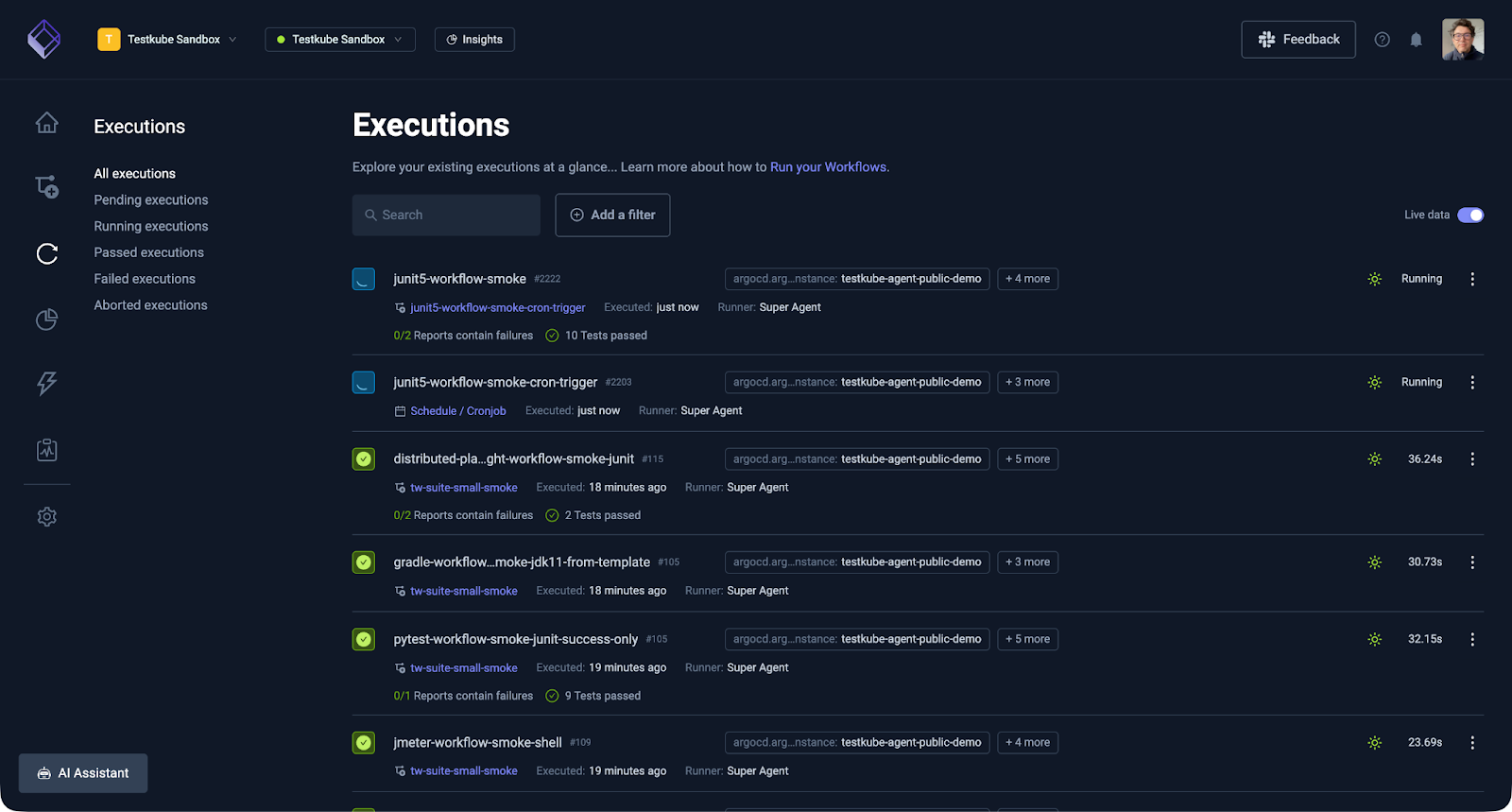
Testkube v1.21 introduces a Unified Executions Dashboard, a centralized observability layer that brings all executions into a single view.
What you can do with the new dashboard
- Create custom views with advanced filtering: Build private or shared views for your executions, using powerful filters, or rely on preconfigured views for common scenarios.
- Direct inspection for faster root-cause analysis: View logs, status, and key metadata directly from the execution list without navigating away.
- Control execution signal noise: Toggle live data on or off to focus on active executions or investigate historical results without interruptions.
This new view lets you quickly spot failures, inspect logs with one click, and take action immediately, without jumping between workflows or pages.
The Executions Dashboard is available via a dedicated icon in the left navigation.
Webhook support for global credentials and variables
Webhooks are how test results reach the rest of your stack: for example collaboration tools like Slack, ticket/incident management tooling like PagerDuty, or BI solutions like DataDog. Keeping those integrations secure shouldn't mean hard-coding secrets everywhere.
With v1.21, webhooks can now reference global credentials and variables using the credentials() expression. Secrets can be injected into webhook URLs, headers, or payload templates without exposing values directly.
Now you can reliably propagate execution data to external tools while managing secrets securely and in one place. No more updating every webhook individually.
Completing the transition to TestWorkflows
Over the past year, TestWorkflows has become the primary way to orchestrate tests in Testkube, offering greater flexibility, better visibility, and continuous improvement driven by user feedback.
With v1.21, we're completing the deprecation of legacy Tests, Test Suites, Executors, and Sources in both the Control Plane and Open-Source Agent. From now on, TestWorkflows is the single and only way to orchestrate and execute tests.
Standardizing on one execution model means less complexity, easier onboarding, and consistent execution metadata, which is what makes unified observability possible.
Important: If you still rely on legacy functionality, you must remain on Testkube v1.20 and migrate your existing Tests and Suites to TestWorkflows before upgrading. Version 1.20 will continue receiving critical bug fixes during this transition.
Migration resources and guides are available in the documentation, and the team is available on Slack to help with the transition.
PostgreSQL for new installations
We're introducing PostgreSQL as an alternative data layer for new Testkube installations as part of our ongoing work to strengthen the platform's execution data foundation.
PostgreSQL brings better performance, scalability, and data reliability, setting the stage for richer execution history, improved queryability, and future analytics and reporting capabilities.
Migration tools for existing MongoDB-based installations will be provided in a future release, and MongoDB support will be deprecated by mid-2026.
Additional improvements and how to get started
This release also includes several usability improvements and fixes, including clearer silent execution indicators, correct credential scope updates when overrides are present, and browser tab titles for execution details.
Together, these changes give teams clearer visibility into test execution across their entire platform, from a unified dashboard to secure external integrations, all built on a stronger data foundation.
As always, a huge thank you to our amazing community for your feedback and support.
About Testkube
Testkube is the open testing platform for AI-driven engineering teams. It runs tests directly in your Kubernetes clusters, works with any CI/CD system, and supports every testing tool your team uses. By removing CI/CD bottlenecks, Testkube helps teams ship faster with confidence.
Get Started with a trial to see Testkube in action.