📣 New for engineering leaders: release confidence in the agentic SDLC. Get the guide →


Ephemeral Environment Testing in Kubernetes
Test every branch, run every PR, and keep every result—even in short-lived environments
Table of Contents














Short-lived environments are great until the cluster you needed to debug is already deleted. Testkube lets you test in them and keep the results after they vanish.
Test automation in ephemeral Kubernetes environments
Ephemeral environments are becoming the standard for fast-moving teams. Platforms like Okteto, Qovery, Shipyard, Garden.io, and vCluster make it easy to spin up a temporary cluster or namespace for each pull request, branch, or feature.
Testkube makes those environments fully testable, just like dev, staging, or production. You run complete test suites in short-lived clusters, trigger executions from your pipeline or CLI, and collect results with no custom setup. And because Testkube uses a centralized control plane, you get test consistency across every environment, ephemeral, long-lived, or remote.
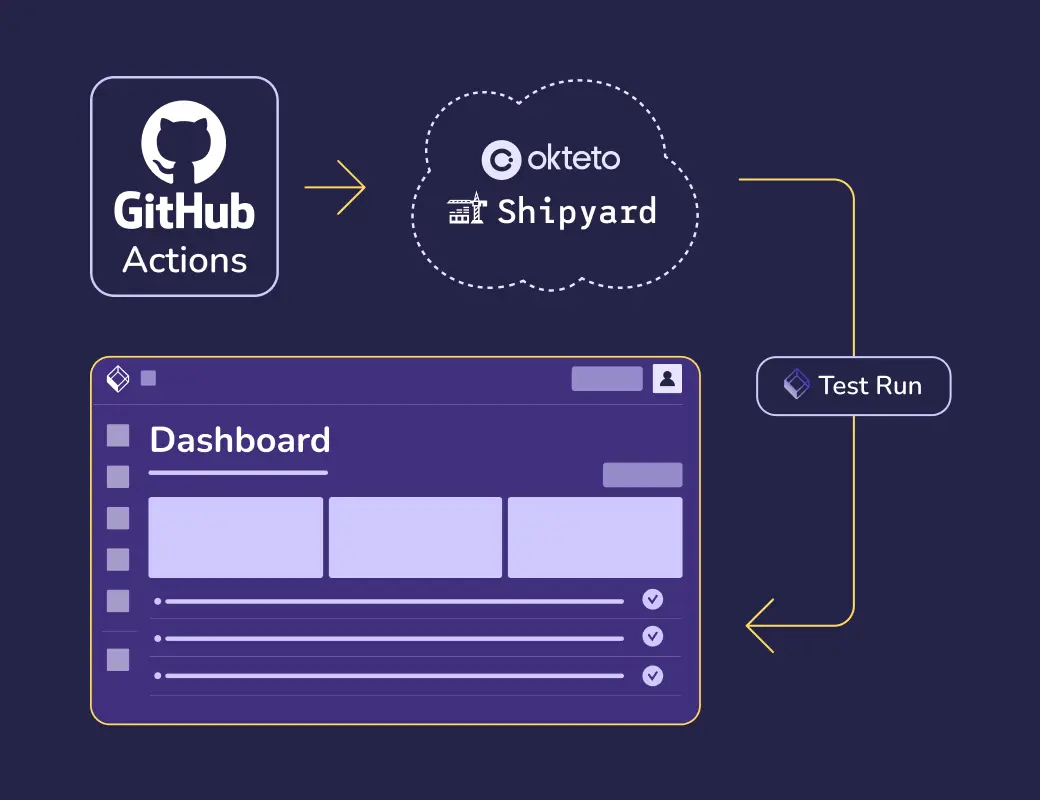
Keep your results after the cluster is deleted
One of the biggest challenges with ephemeral testing is losing access to logs, artifacts, and result history once the environment is gone.
Testkube solves that by storing every test result centrally, even after the underlying namespace or cluster is deleted. Wherever you build, Kubernetes-native testing becomes a natural part of your workflow rather than something you have to preserve by hand.
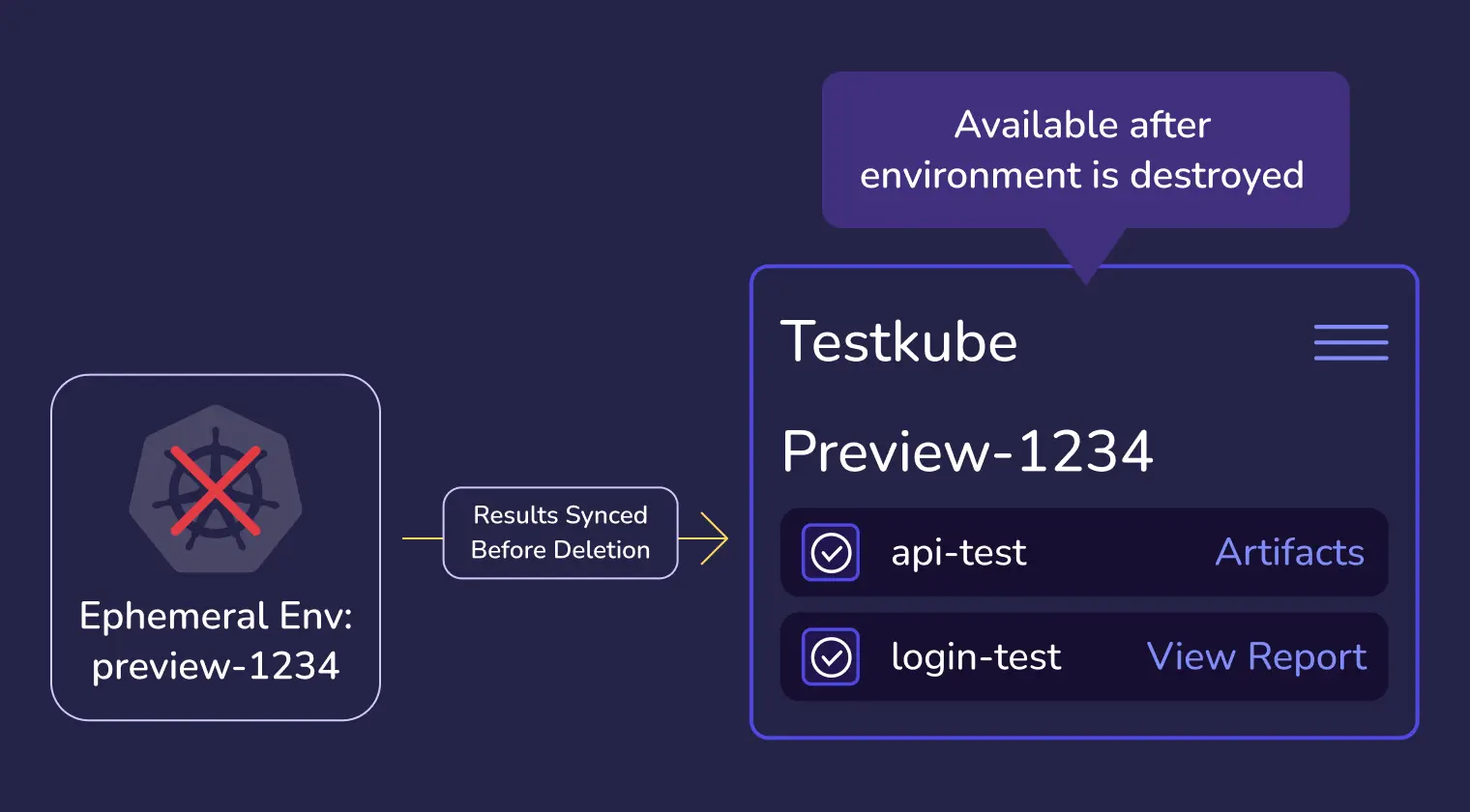
Workflows that match your ephemeral setup
Whether you provision entire clusters or just temporary namespaces, Testkube adapts to how your team builds and tests. Every run connects back to a central control plane, so results stay visible, comparable, and easy to trace. Ephemeral testing becomes a core part of your release pipeline instead of a workaround bolted onto it.

Multi-agent support for fully isolated runs
Testkube supports a multi-agent model built for fully isolated testing in dynamic clusters. When your CI/CD pipeline provisions a short-lived environment, it can install a lightweight runner agent in that environment, trigger a test workflow through the Testkube CLI or API, and automatically tear the agent down once the test completes. Each result is linked to its origin environment, so you keep full traceability even after the cluster is gone.
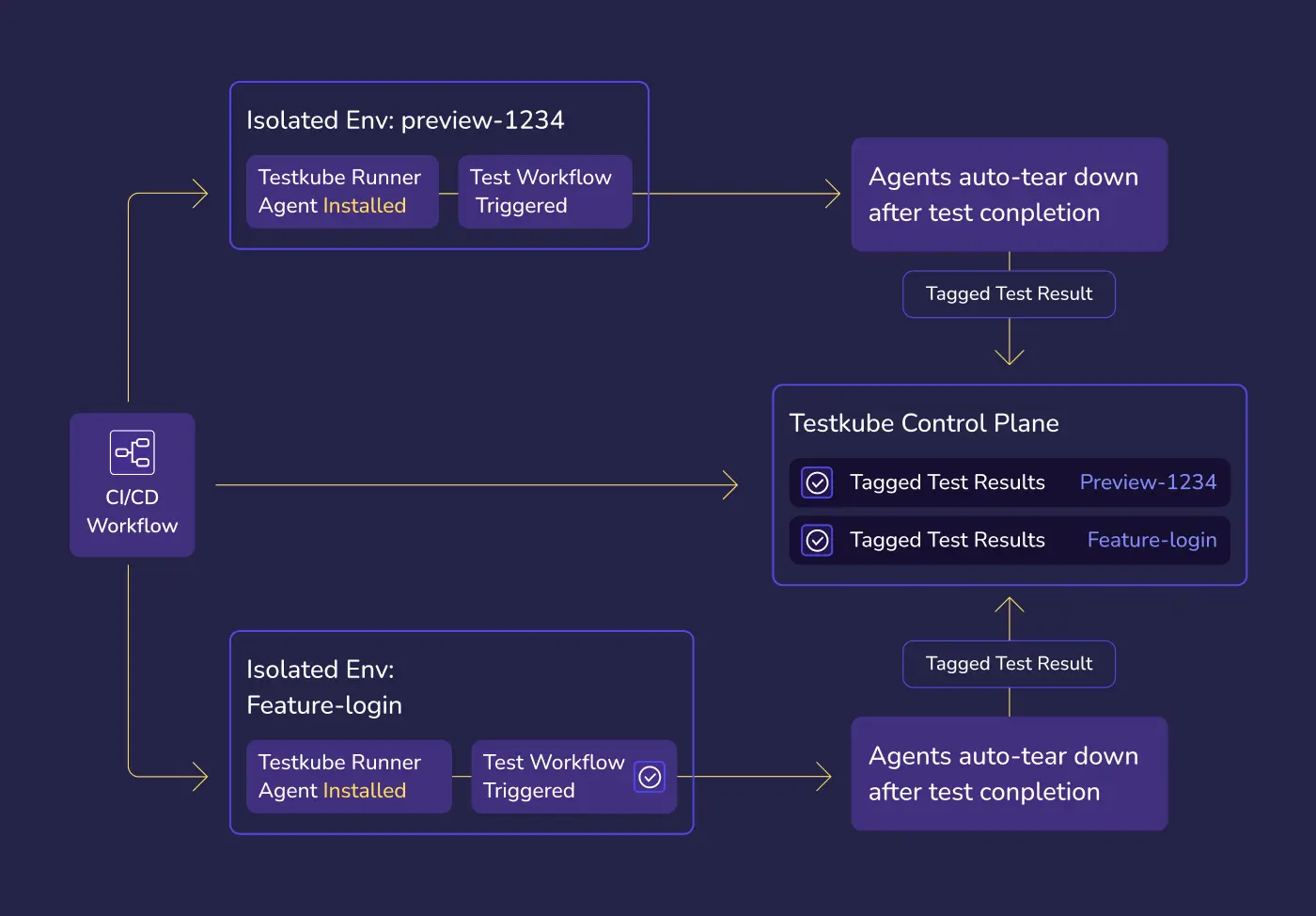
Ephemeral testing in your CI/CD pipeline
Testkube is built for automation. Spin up ephemeral environments with platforms like Okteto, Qovery, Garden, or Shipyard, then trigger test workflows through any of:
- CI/CD pipelines, including GitHub Actions, GitLab, and Jenkins.
- Kubernetes events.
- GitOps workflows.
- Manual or scheduled execution.
Testkube also supports floating licenses and unlimited runner agents, so you can run tests in parallel across many environments without hitting a bottleneck.
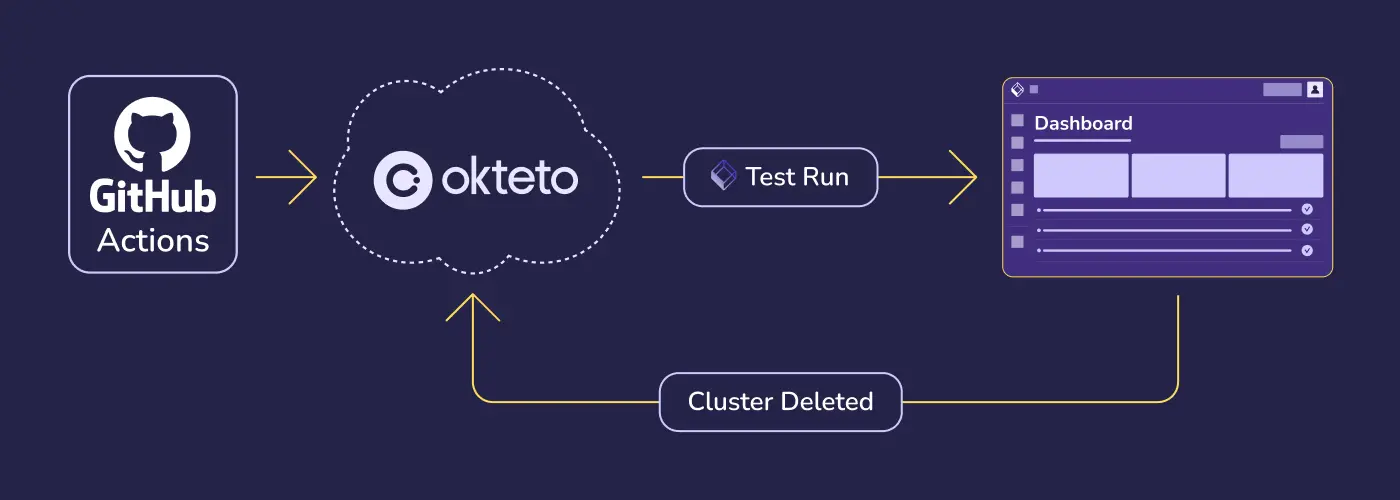
Why teams run this on Testkube
Ephemeral environments solve the cost and contention problems of always-on staging, and they create a new one: the results disappear with the cluster. Testkube closes that gap. Tests run inside the short-lived environment through a runner the pipeline installs and tears down, and the logs, artifacts, and history land on a central control plane that outlives the cluster. You keep the speed of ephemeral infrastructure and the traceability of a permanent system.
Make ephemeral environments first-class for testing
A cluster that exists for one PR should still give you testable, traceable results. Testkube runs your suites inside short-lived environments, links every result to where it came from, and keeps it all centrally after teardown, so ephemeral testing is part of the pipeline instead of a workaround.
Test faster, ship with confidence, and stay in control.
Run any test, anytime, anywhere
Curious how Testkube can support your team's testing strategy?
Fill out the form and we'll walk you through what's possible.