Table of Contents
Start your free trial.
Start your free trial.

Start your free trial.



Table of Contents
Executive Summary
The Evolution of Platform Engineering
Platform engineering has moved beyond provisioning infrastructure and managing CI/CD pipelines. Today, it focuses on improving developer experience, standardizing infrastructure, and building internal tooling that allows teams to ship software reliably and consistently.
In cloud-native environments, complexity has increased dramatically. Microservice architectures introduce multiple repositories, independent deployment pipelines, service meshes, and heterogeneous runtimes. Each team chooses different frameworks, testing tools, and CI configurations. While this flexibility accelerates innovation, it often creates fragmented testing practices and operational blind spots.
As organizations scale, platform engineering must address not just how applications are deployed, but how they are validated. Reliability and quality assurance can no longer be treated as downstream activities. The next stage in platform maturity is shifting from platform orchestration to platform-driven testing, where testing becomes a first-class capability of the internal platform itself.
Why Testing Needs a Unified Approach
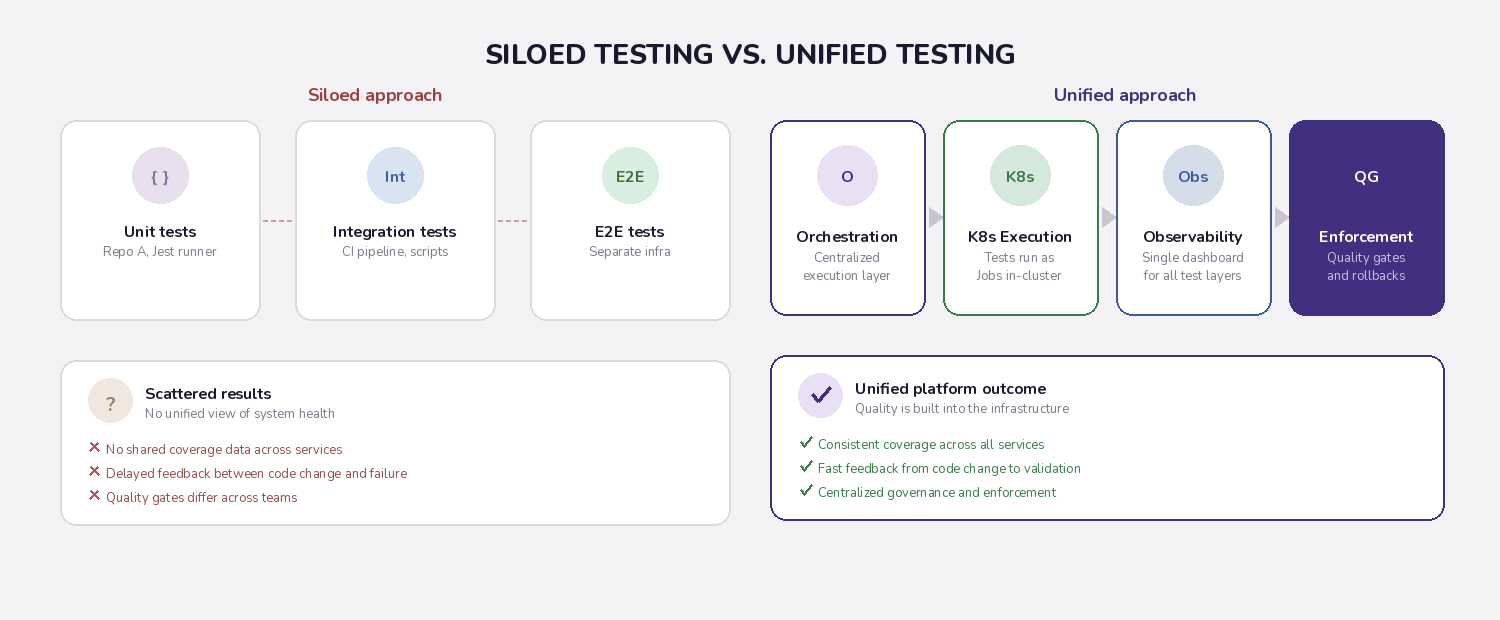
In many organizations, testing evolves organically. Unit tests live inside service repositories. Integration tests run in CI pipelines. End-to-end (E2E) tests are maintained separately, sometimes in entirely different frameworks or even separate infrastructure.
This siloed model creates several problems:
- Inconsistent coverage: One service may have extensive unit tests but minimal integration validation. Another may rely heavily on E2E tests but lack contract tests.
- Delayed feedback loops: Integration or E2E tests often run only after deployment to staging, increasing the time between code change and failure detection.
- Lack of centralized enforcement: Quality gates differ across teams. Some pipelines enforce coverage thresholds, others do not. Standards become optional rather than mandatory.
These issues surface in measurable ways. Rising flaky test rates, repeated failed deployments, and regression bugs escaping to production are indicators of platform-level testing gaps. When testing is decentralized without governance, the platform team loses visibility into overall system health.
The solution is not to centralize test logic under one team. Instead, it is to centralize the testing infrastructure, execution model, and observability layer.
Unified Testing: A Platform-Centric Approach
Unified testing treats QA as a first-class citizen of the platform. Instead of developers managing their own test runners and reporting tools, the platform provides a standardized execution layer. The core principles of Unified testing are as follows:
- Centralized Test Management: A single orchestration layer manages unit, integration, functional, and contract tests. This ensures that regardless of the framework used (e.g., Playwright for UI or Go for unit tests), the execution logic remains consistent.
- Infrastructure-Agnostic Execution: Tests should not be "special snowflakes" that only run on a developer's machine. A unified approach ensures the same test artifact runs identically in dev, staging, and production clusters.
- Deep Observability: By aggregating results into a unified dashboard, platform engineers can identify patterns of flakiness and performance degradation across the entire distributed system.
Unified Testing with Testkube
To implement this vision, platform teams require tools that are native to the environments where the applications live. This is where Testkube fits into the modern stack. Testkube is a Kubernetes-native test orchestration framework that decouples test logic from the CI/CD pipeline.
Key Technical Capabilities
- Containerized Test Execution: Testkube runs tests as Kubernetes Jobs. This means your tests scale naturally with your cluster and have direct access to the internal network of your microservices, eliminating the need to expose sensitive endpoints to external CI runners.
- Multi-Framework Support: It acts as a wrapper for popular tools. For example, you can trigger a Cypress suite for frontend validation and a Postman/Newman collection for API testing through the same CRD (Custom Resource Definition) in Kubernetes.
Seamless CI/CD Integration: Instead of writing complex shell scripts in GitHub Actions or Jenkins, your CI pipeline simply calls a Testkube trigger. The heavy lifting of execution and log aggregation happens within the cluster.
Implementing Unified Testing on Your Platform
Implementing unified testing means embedding testing directly into the platform architecture rather than treating it as a separate CI step. Testing becomes a core platform capability, governed centrally but executed across all services in a consistent way.
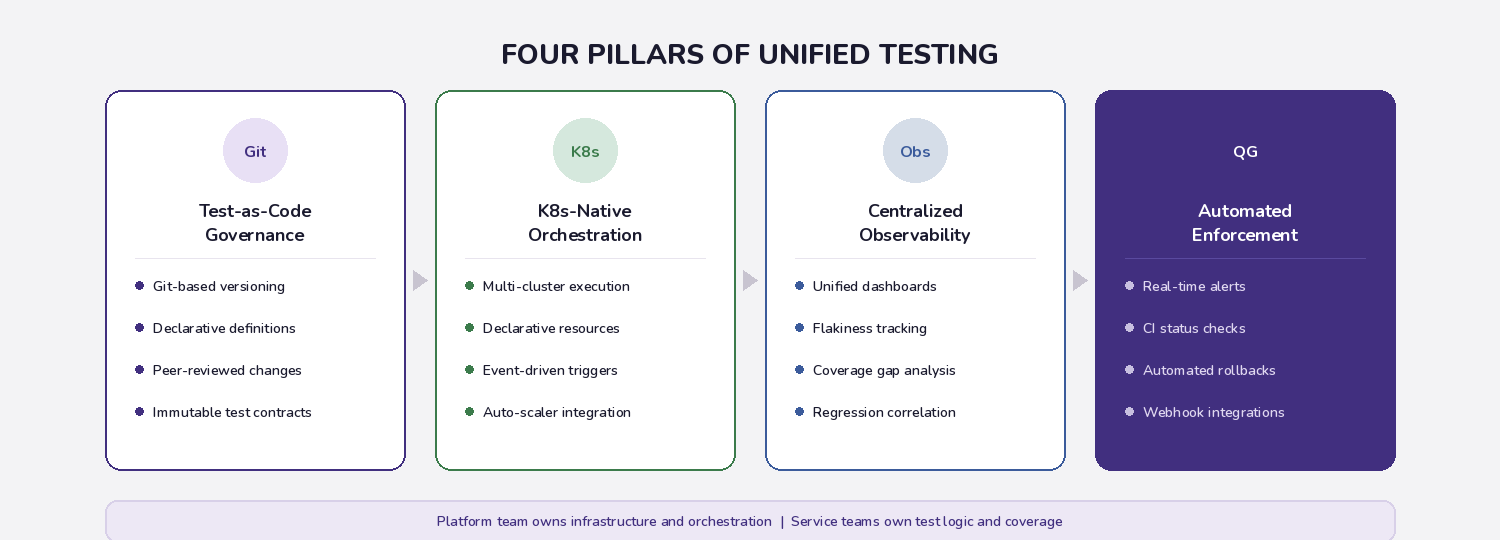
Below are the key pillars for implementation.
Test-as-Code Standards and Governance
Define test-as-code standards by treating test artifacts suites, environments, assertions like infrastructure-as-code. This ensures consistency through Git-based versioning, declarative definitions, and peer-reviewed changes, mirroring tools like Terraform or Helm. Teams maintain immutable test contracts across branches, preventing drift between dev and production environments.
Kubernetes-Native Test Orchestration
Orchestrate tests using Kubernetes-native tools like Testkube, which schedule executions across multi-cluster environments through declarative resources. These tools enable centralized control over how tests are executed across services, ensuring consistent policies, standardized workflows, and coordinated regression runs within a unified testing framework. Tests can be triggered by Git events, deployments, or scheduled workflows, while resource contention is managed through integration with the cluster auto-scaler to ensure efficient capacity handling.
Centralized Observability and Quality Metrics
Centralize observability by aggregating results from all test layers, unit coverage reports, integration test spans, and end-to-end execution traces into unified dashboards. This enables precise tracking of pass and fail rates by service and environment, flakiness ratios calculated over rolling windows, coverage gaps across critical code paths, and deployment impact correlations that highlight regression patterns after releases.
Automated Enforcement and Feedback Mechanisms
Automated feedback loops at the platform layer by configuring policy engines to trigger real-time alerts through integrated notification systems, block source code merges via CI status checks, initiate automated rollbacks when critical test thresholds are not met, or pause traffic shifts during progressive delivery. Additionally, use outbound webhooks to push structured test results and status events to external systems such as incident management, chat platforms, or custom automation services for further workflow integration.
Clarifying Ownership and Responsibility
A common pitfall in platform engineering is the "bottleneck" effect, where the platform team becomes responsible for writing every test. To succeed, the responsibilities must be clearly delineated:
Technical Outcome
By moving testing into the platform layer, organizations eliminate the "it works in CI but fails in the cluster" syndrome. Platform engineers gain full control over the testing pipeline's security and resource consumption, while developers gain the ability to deploy safely at speed. The result is a more resilient system where quality is a built-in feature of the infrastructure, not a checkbox at the end of a sprint.
Conclusion
Centralizing and standardizing testing across microservices and pipelines is critical to reducing flakiness and strengthening system reliability at scale. By leveraging platform-native solutions like Testkube, teams can achieve scalable, environment-agnostic test execution with consistent orchestration and unified observability across clusters. When testing is embedded directly into the platform, QA becomes a first-class capability rather than a downstream activity, enabling automated quality enforcement and faster, safer deployments.
If you’re looking to modernize your testing strategy, connect with the Testkube team to discuss how unified, Kubernetes-native testing can be implemented in your environment.
{{banner-get-started}}
About Testkube
Testkube is the open testing platform for AI-driven engineering teams. It runs tests directly in your Kubernetes clusters, works with any CI/CD system, and supports every testing tool your team uses. By removing CI/CD bottlenecks, Testkube helps teams ship faster with confidence.
Get Started with a trial to see Testkube in action.