🚨 AI Test Creation Live Webinar - Oct 8 → Save your seat


Geo-Distributed Clusters with Multi Cluster Kubernetes
Table of Contents











Your users reach you from Tokyo to Toronto, from São Paulo to Stockholm. Testing from a single location tells you nothing about what most of them actually experience.
Single-location testing hides what users feel
Network latency, regional infrastructure, and CDN behavior vary dramatically across regions. An application that performs flawlessly for users in Virginia might crawl for users in Singapore or São Paulo. Test from one location and you get idealized results that mask the real-world performance the majority of your users live with.
The usual ways around this each carry a cost. Third-party testing clouds promise global coverage but bring steep pricing, security concerns about routing sensitive data through external services, and limited fit with modern DevOps workflows. DIY distributed setups take real engineering time to build and coordinate across regions. And ignoring the problem leaves region-specific issues to surface in production, where they are hardest to diagnose.
Run tests where your users are
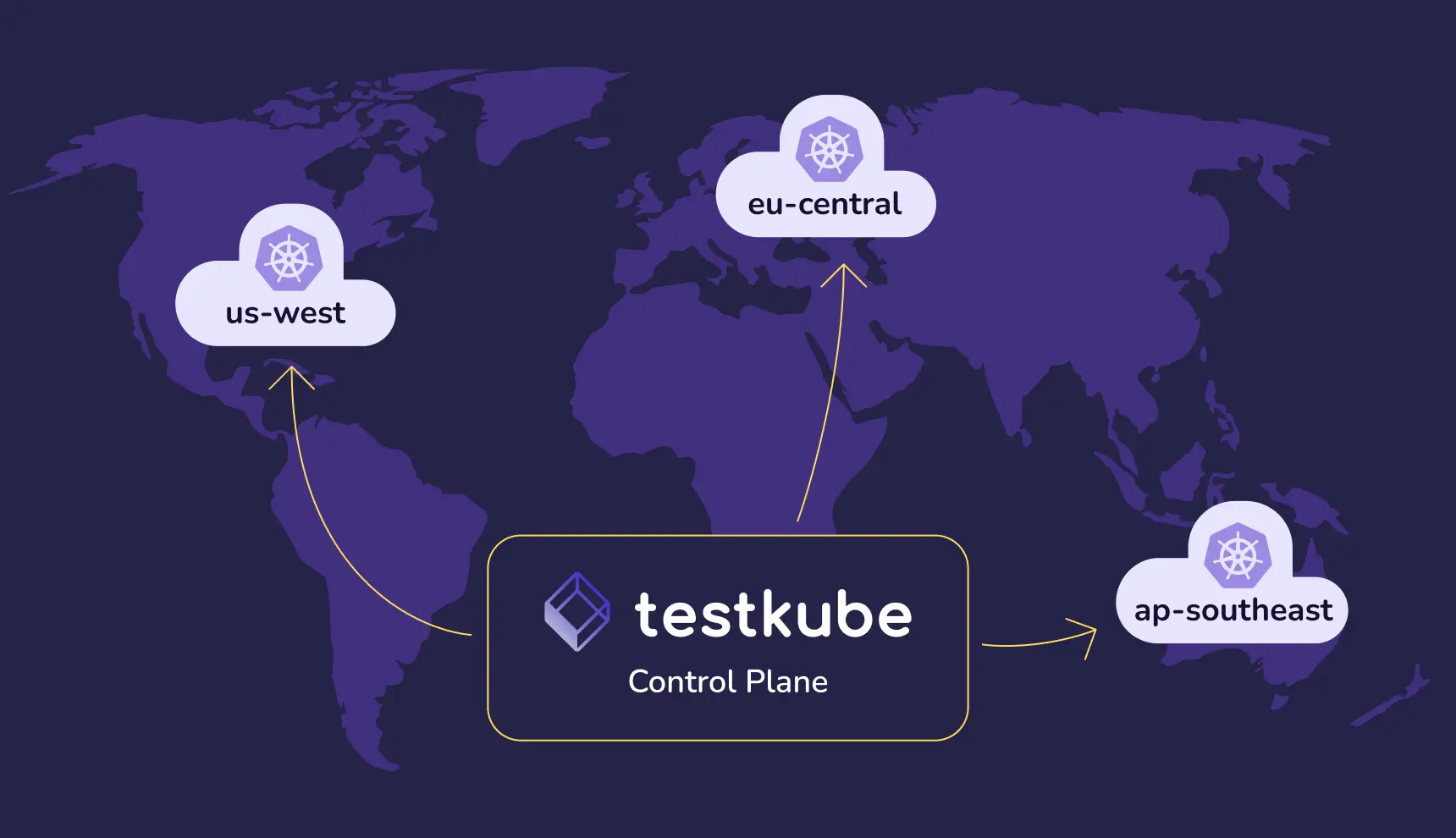
Testkube runs your tests from the regions that matter, using the Kubernetes clusters you already operate across AWS, Azure, GCP, or edge locations. Local agents execute inside each regional cluster, and a central control plane coordinates the runs and collects the results. Traffic never routes through a third party, and test data never leaves your infrastructure.
That gives you realistic performance data matched to actual user experience, full infrastructure control with no vendor lock-in, better security because data stays in your clusters, and lower cost because you use infrastructure you already run.
How it works across regions
- Connect a Kubernetes cluster in each target region to the Testkube control plane with a local agent.
- Define your tests once as Test Workflows, using the tools you already run (k6, Playwright, Cypress, Selenium, JMeter, Postman, or custom scripts), with no rewrites.
- Run the same workflow across regions, in parallel when you want, with sharding to split large suites and distributed execution to spread load across the cluster.
- Trigger from any CI/CD platform, a cron schedule, a Kubernetes event, or the API and CLI.
- Review every region's results, logs, and artifacts in one dashboard, and drill down by cluster, time period, or test.
What you keep, what you gain
Why teams run this on Testkube
Third-party testing clouds can give you global coverage, but at the price of usage-based cost, data leaving your environment, and limited DevOps fit. Building it yourself means coordinating agents across regions by hand. Testkube gives you the regional reach without either trade-off: tests run as Kubernetes jobs inside the clusters you already own, with any tool you already use, and results aggregate to one control plane. You keep ownership, data sovereignty, and your existing toolchain, and still see how the application behaves in every region.
Test globally, see it in one place
A global application needs testing that reflects where its users are. Testkube runs your tests in regional clusters you already operate and brings every result back to one control plane, so regional performance differences show up before your users find them.
Test faster, ship with confidence, and stay in control.
Run any test, anytime, anywhere
Curious how Testkube can support your team's testing strategy?
Fill out the form and we'll walk you through what's possible.