Table of Contents
Further Reading

No items found.
📊 The Testing Maturity Gap: a 5-level model for Kubernetes testing. Find your level →


This is a fictional but representative engineering organization. It is not a customer, nobody in it is a real person, and nothing in it is a quote. The numbers about the organization are arithmetic, with the inputs shown.
Eight months ago one of the four built a small testing agent to run agent-written tests against staging, after the agents' own sandboxes had let two bugs through. It worked, so it grew. A wrapper for each coding agent, because each one calls tools differently. A results store, because chat transcripts vanish. A retry script. A script that decides what counts as flaky. A dashboard, because a VP asked for one. Together it is a testing platform that nobody decided to build, and one person understands it. That person has given notice.
Here's the math: one engineer, roughly a third of their time, for eight months, plus about a month for a replacement to learn it well enough to change anything safely.
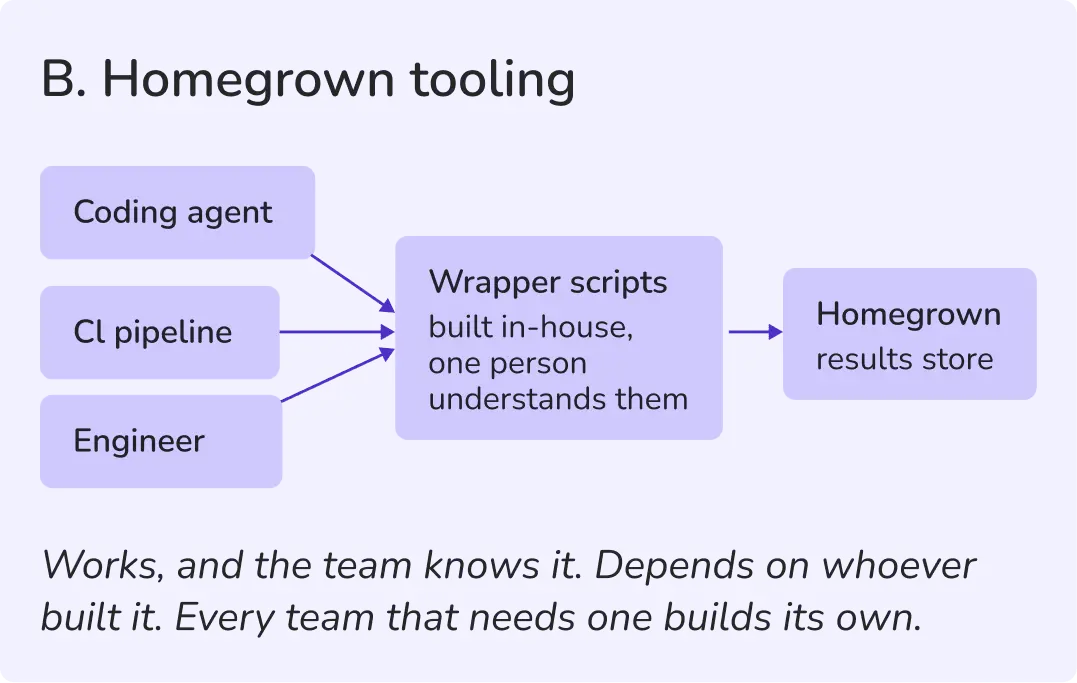
Works, and the team knows it. Depends on whoever built it. Every team that needs one builds its own.
The caution behind it is sensible. Most teams do not let agents run unsupervised, and that is exactly why wrappers like this one get built.
They had three options: document the tooling and assign a second maintainer; rewrite it properly as an internal product; or replace it with a shared service and keep only the parts that held knowledge the service did not have. They chose the third.
The developers did not change how they work. Their agents write tests the same way; the tests go somewhere now. The platform team is back to four people doing platform work, and the next person to join does not inherit a tool only one predecessor understood.
Migrating 60 developers' agent configurations took longer than planned. It is also fair to say that a team with a stable maintainer and tooling that had stopped growing could reasonably have chosen to keep it. The case for replacing homegrown tooling gets stronger as it grows and as the number of people who understand it shrinks.