.webp)
Table of Contents
Start your free trial.
Start your free trial.

Start your free trial.


Table of Contents
Executive Summary
When a test fails in your pipeline, someone has to figure out why. They pull up logs. They re-run the test to see if it happens again. They write up what went wrong and post it somewhere the team will see it. Then they do it again for the next failure, and the one after that.
This is not analysis. It is triage. It is predictable, repeatable, and it happens dozens of times a week on any team running tests at scale. The engineers doing it are not doing it because it requires their expertise. They are doing it because no one has made it automatic.
CI/CD tools execute workflows. Testing tools execute tests. Testkube orchestrates testing as a system, including what happens after tests complete. That distinction is what this release is built on.
What this release gives you
The March 2026 release introduces two things that change the shape of how your team works with test results.
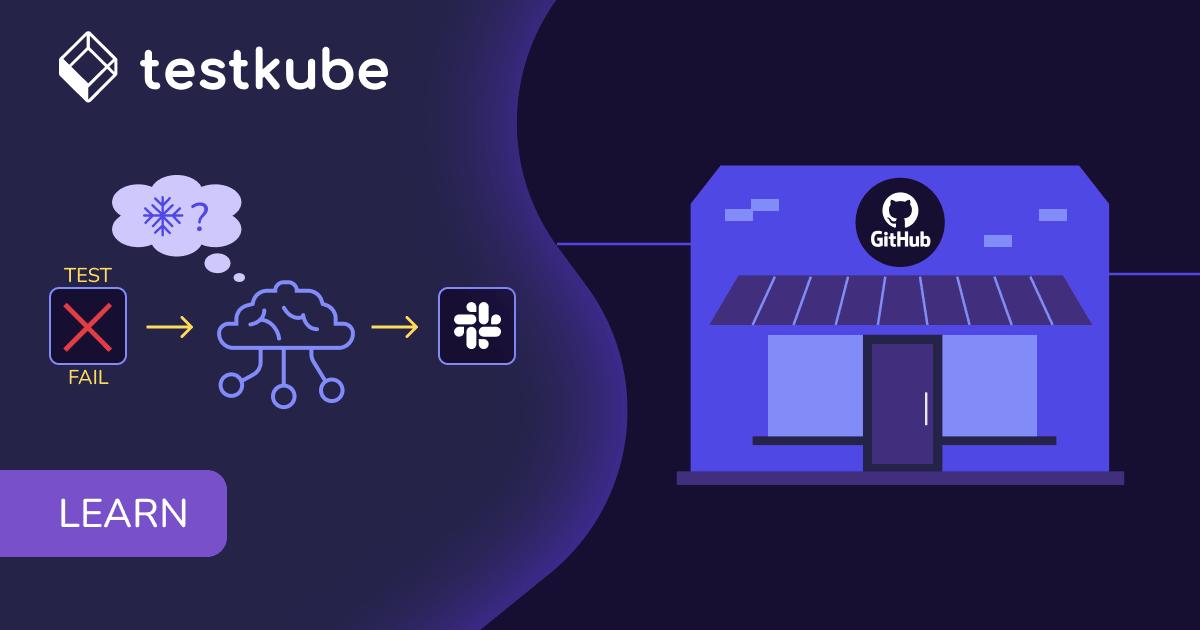
First: autonomous AI agents that respond to workflow execution outcomes. When a workflow fails, an AI agent can now investigate, rerun the test to determine whether it is a flaky test or a real failure, generate a structured summary, and post it to Slack or your ticketing system. No human trigger required. The agent fires on the outcome.
Second: the Workflow Marketplace, a public GitHub repository integrated into the Testkube Dashboard for sharing and discovering infrastructure testing workflows. If you are building infrastructure validation workflows on Kubernetes, you no longer start from zero.
Autonomous agents: what they actually do
When a workflow fails, an AI agent responds. It investigates, reruns, summarizes, and posts. Engineers handle the failures that require judgment, not the ones that require presence.
The AI agent model in Testkube has evolved to respond to what your tests actually do. Specifically: when a workflow completes and, more precisely, when it fails, a configured agent can now respond automatically.
Here is what that looks like in practice. A workflow runs across your clusters. One node fails. The AI agent fires. It pulls the failure context, reruns the affected test to determine whether the failure is reproducible or flaky, generates a structured summary with that determination, and posts it to the Slack channel or ticketing system your team uses. Your engineers get a summary with a conclusion, not a log file with a question mark.
The repetitive part of test failure investigation is now optional. The part that requires judgment, the investigation that actually benefits from a senior engineer looking at it, remains for your team.
Workflow Marketplace
Infrastructure tests for Kubernetes clusters and components tend to get rebuilt from scratch at every organization that runs them. The Workflow Marketplace changes that. It is a public GitHub repository integrated into Testkube that lets teams share, discover, and adopt infrastructure testing workflows maintained by us and the community.
If your team needs to validate that cluster networking behaves correctly after a configuration change, or that secrets management is working across environments, the Workflow Marketplace gives you a starting point before building a workflow from scratch. It is designed to make common workflow patterns easier to discover and reuse, so your team can focus on the ones specific to your system.
Check out the repository at https://github.com/kubeshop/testkube-marketplace
What else is in this release
Beyond the two headline features, April 2026 includes a set of operational and AI-layer improvements.
- LLM model selection and BYOLLM for cloud: Cloud users can now configure which LLM models Testkube AI features use, and bring their own LLM. For organizations with model licensing requirements or internal AI governance constraints, this means the AI layer works the way your organization requires it to.
- AI chat panel redesign: A persistent side-panel layout for AI interactions, similar to the Cursor or Vs-Code interaction model.
- Integrated MCP Registry: Browse the official MCP Registry when connecting MCP Servers to Testkube AI Agents.
- Improved MCP Tools: Natural language time references now work in execution queries. Queries like "yesterday's failed tests" resolve correctly. We’ve also added tools for managing TestWorkflowTemplates - to give you AI Agents deeper access to Testkube functionality.
- Key rotation and Credentials Vault integration: API credential rotation support and native integration with external secrets vault systems, for teams managing credentials at scale. Check out the documentation for Key Rotation, and Vault integration to learn more.
- Fail-fast for parallel execution: When one node fails in a parallel execution across Playwright or Selenium nodes, the remaining nodes stop. This saves compute and shortens feedback loops. Available for paid customers. See docs →
- Add/remove execution tags: Dynamic tagging of test executions for flexible organization and filtering. See docs →
- Improved timeout handling: Support for multiple timeout mechanisms, each handling a different stage of execution. See docs →
- Backstage Plugin: Native Testkube plugin for Backstage developer portals that allows organizations to surface Testkube execution results in their Backstage portal. See docs →
- Pass results between workflow steps: Enables advanced workflow construction by passing outputs from one step as inputs to the next. See docs →
- Inline attachments into JUnit reports: View screenshots produced during failed tests together with your test results for faster fault assessment. See docs →
- Authenticate with multiple GitHub Orgs: Associate multiple GitHub organisations with your Testkube instance for enhanced security controls. See docs →
Wrapping up
The throughline across this release is the same pattern: identify the work in your testing pipeline that is predictable and repetitive, and make it something Testkube handles. Autonomous AI Agents do this for the post-failure triage cycle. The Workflow Catalog does it for workflow creation. The operational improvements across credentials, resilience, and execution control do it for the infrastructure that runs underneath.
Test orchestration at scale means the platform handles the repeatable parts so your engineers focus on the ones that require their judgment.
Start a free trial, or join Ole and the team for the April launch webinar to see the autonomous agent workflow and Workflow Catalog in a live demo.
{{banner-get-started}}
About Testkube
Testkube is the open testing platform for AI-driven engineering teams. It runs tests directly in your Kubernetes clusters, works with any CI/CD system, and supports every testing tool your team uses. By removing CI/CD bottlenecks, Testkube helps teams ship faster with confidence.
Get Started with a trial to see Testkube in action.