Table of Contents
Start your free trial.
Start your free trial.

Start your free trial.



Table of Contents
Executive Summary
When your platform scales to dozens of teams and hundreds of services, quality becomes a platform problem. Individual teams might write excellent tests, but without consistent enforcement of quality standards across teams and services, you end up with unpredictable releases and production incidents.
Without a common way to define, enforce, and observe quality across teams, organizations end up with uneven release of confidence, manual approvals, and fragile audit trails. This is where continuous quality governance comes in.
In this post, we’ll show how platform teams and engineering leaders can enforce consistent quality, automate checks, and gain visibility across teams and services.
The Problem: Quality at Scale
In the early days, teams own quality, defining their own tests and standards. This works when teams operate independently, and systems are small. As organizations introduce platforms to manage shared infrastructure, environments, and delivery workflows across teams, quality expectations also need to scale. Without that shift, decentralized quality quickly leads to inconsistent outcomes and unpredictable releases.
Different Meanings of “Done”
Consider a platform supporting twenty teams. One team defines “done” as passing unit tests, another requires integration tests, and a third runs end-to-end tests. Each approach works in isolation, but the platform has no way to enforce consistent quality standards or visibility into what quality actually means for each service. This challenge has become more visible with the rise of microservices, dedicated platform teams, faster release cycles, and increasing compliance and audit requirements.
Shared Environments, Shared Risk
All services pass their pipelines, get promoted, and land in shared or production environments. Then something fails. The failure often comes from an integration path that was never tested because that team’s definition of quality didn’t require it. From the platform’s point of view, every service looked equally “green,” even though their real readiness levels were very different.
Increased Velocity Exposes the Gaps
This inconsistency becomes more painful as delivery speed increases. Pipelines grow more complex, releases happen more often, and manual checks creep in. Release managers start asking for sign-offs. QA teams collect screenshots, reports, and links just to prove that tests ran. Audits turn into a scramble for evidence scattered across CI logs, test tools, and team-specific dashboards. None of these problems are caused by teams doing bad work. They are symptoms of decentralized quality in a system that now depends on shared infrastructure and coordinated delivery.
Platform engineering exists to remove friction and standardize how teams deliver software without slowing them down. When quality rules live only inside individual pipelines or team conventions, the platform has no way to reason about risk, readiness, or compliance.
Continuous quality governance shifts quality from being a set of informal practices to a system that is defined, enforced, and observed at the platform level. This does not mean taking control from teams. It means setting clear minimum standards that apply everywhere, while still allowing teams to choose how they meet them. If you are interested in seeing how this plays out in practice, check out our post on the intersection of GitOps and TestOps in a platform engineering context.
What Continuous Quality Governance Actually Means
Continuous Quality Governance differs fundamentally from test execution; while tests focus on verifying behavior, governance is about policies, enforcement, and visibility. Running tests in a pipeline is execution. Defining which tests must pass before deployment, automatically blocking failed releases, and tracking compliance across services is governance.
Continuous means quality checks happen at different stages across the entire SDLC, from pull requests to deployment , not just before major releases. Point-in-time controls like release-day sign-offs catch problems too late. Governance establishes policies defining what must be true for code to progress. One policy might require integration tests to pass before merging to main. Another might mandate performance tests before production deployment. These are automated gates that block progression when criteria aren't met, replacing manual approvals with consistent enforcement.
Visibility means leadership sees quality health across the platform in real time through dashboards showing which services pass their gates, which fail, and what trends emerge. Quality rules become platform-managed assets versioned in Git and applied consistently. When standards need raising, the platform updates one policy definition rather than asking twenty teams to change their pipelines individually.

Core Technical Components
Quality Policies are stored as code, versioned in Git, and managed by the platform team. A base policy might require unit tests to pass, code coverage above 70%, and no critical security vulnerabilities. Teams can extend this for service-specific requirements but cannot remove baseline requirements the platform enforces universally.
Quality Gates enforce policies at specific pipeline points. Pre-merge gates require tests to pass before code merges to main. Pre-deploy gates block deployment until integration tests are complete. Post-deploy gates run smoke tests and trigger rollback on failure. Each gate operates automatically without manual approval.
Test Result Aggregation normalizes results from different testing frameworks into a common format. Whether teams use Jest, Pytest, or JUnit, the platform collects results, translates them to a standard structure, and evaluates them against defined policies. This makes governance decisions consistent regardless of testing tools. Pipeline integration ensures policy enforcement across CI/CD tools like GitHub Actions, Jenkins, GitLab CI, so teams cannot bypass checks by switching tools.
Operational Benefits
Continuous quality governance enforces minimum standards while preserving team autonomy. Teams are free to choose how they test, as long as they meet shared expectations. This balance reduces friction while improving reliability.
Evidence collection happens automatically during delivery. Every test run generates metadata: what was tested, when, results, who triggered it, which commit. This evidence stores persistently and links to deployments. When auditors ask which tests ran before a specific production deployment six months ago, the answer is immediately available with complete traceability from policy to execution to deployment decision.
Traceability works both directions. You can trace from policy definition to every test execution enforcing that policy to every deployment decision based on those results. If a policy changes, you see exactly which services were affected and how quality metrics evolved. This continuous evidence collection eliminates audit-time scrambles to reconstruct testing activity from incomplete records.
Leadership gains actionable visibility. Instead of isolated pipeline results, they can see quality trends over time, signal completeness across services, and platform-level quality health. Decisions are based on data, not anecdotes. Manual QA sign-offs decrease because outcomes are repeatable and enforced automatically. Fewer subjective decisions lead to more predictable releases.
How Testkube Supports Continuous Quality Governance
Testkube supports continuous quality governance by managing tests as Kubernetes-native resources, enabling platform-wide enforcement through orchestration, triggers, and unified insights. This approach ensures consistent quality checks across diverse teams, tools, and pipelines without embedding tests in individual CI/CD steps.
Platform-Level Test Orchestration for Quality Gates
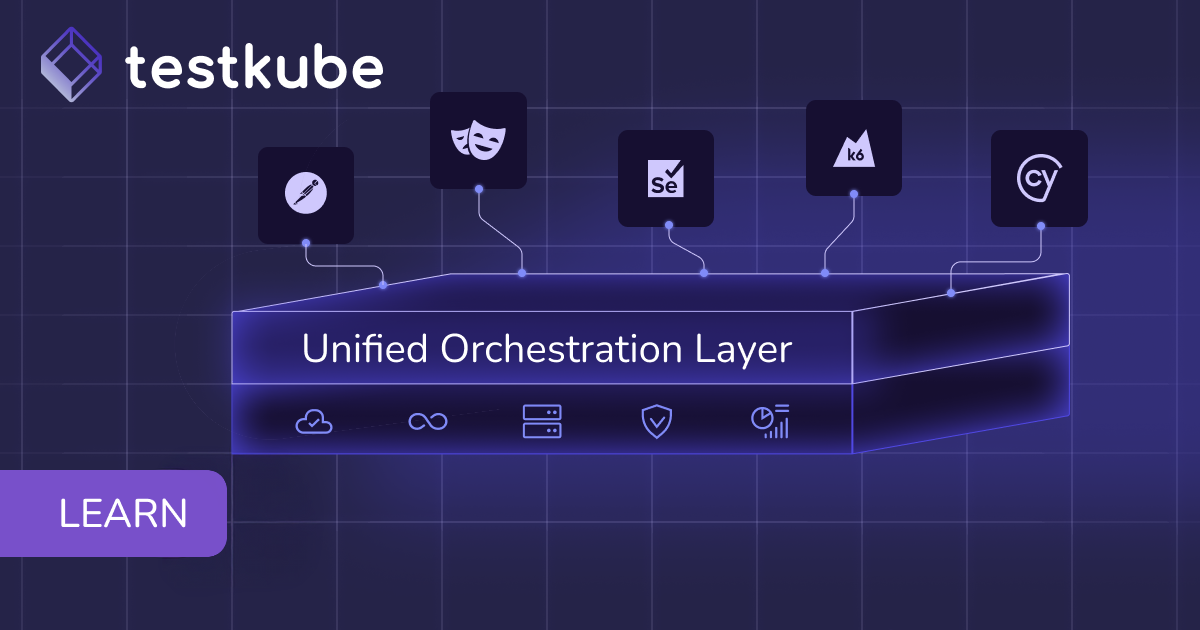
Testkube treats tests as platform-managed resources rather than pipeline steps. Tests run through a centralized orchestration layer instead of embedding individual CI/CD pipelines. This decouples execution from specific implementations and enables consistent quality control enforcement across teams regardless of tooling.
Event-Driven Triggers as Quality Gates
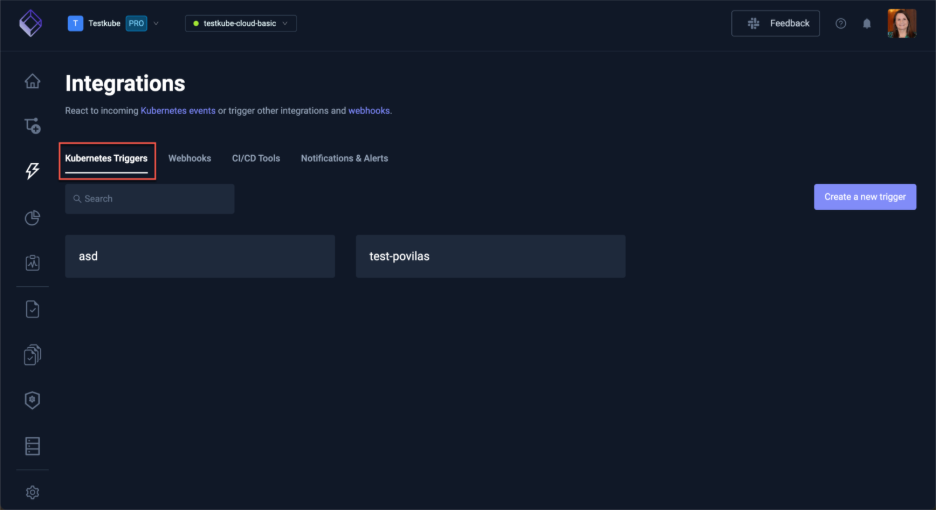
Quality gates are implemented through event-driven triggers listening for Git, CI, or deployment events and automatically running specified tests. When a developer pushes code, a trigger fires pre-merge tests. Failed tests block the merge. When deployment starts, another trigger runs pre-deploy tests, and deployment waits for passing results. This creates automated enforcement making quality governance practical at scale.
Standardized Quality Signals Across Teams
Testkube supports any testing framework for consistent execution behavior. Teams can use Jest, Cypress, K6, Postman, or any other preferred framework, Testkube runs them through the same orchestration layer and normalizes results into a standard format helping in governance decisions. The platform evaluates policies requiring integration tests without knowing which framework teams use, providing tool flexibility while maintaining governance consistency.
Centralized Observability for Quality Governance
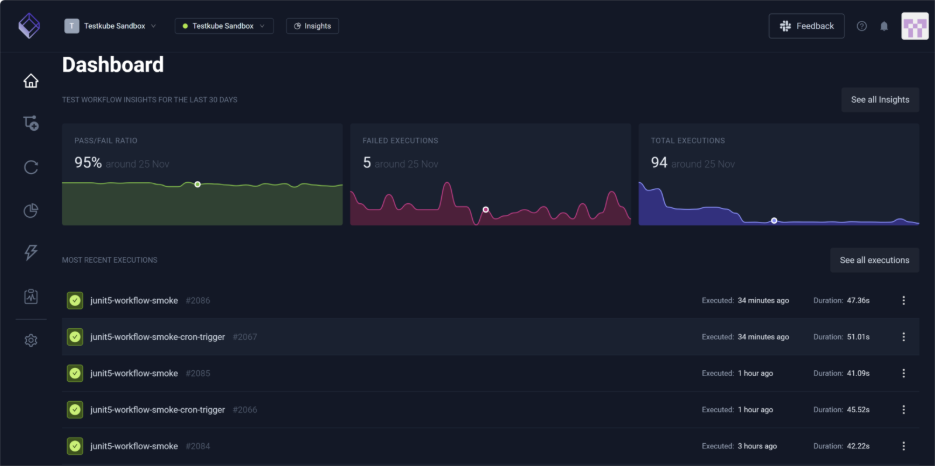
Observability is centralized across the platform. All test executions appear in a unified view regardless of triggering team or framework. Platform teams see pass rates, failure patterns, flaky tests across the organization, and can drill into specific executions to understand failures or blocked deployments. This centralized visibility makes platform-level quality governance actionable.
Traceability and Audit-Ready Execution Data
Execution history is persistent and queryable, storing complete metadata about every test run like which tests executed, results, triggers, tested commits, and execution duration. This supports traceability and audits. You can query history with Testkube to answer which services deployed without integration tests last month or what the average performance test failure rate is across services, transforming quality governance from a snapshot into a continuous record.
Conclusion
Quality problems at scale are platform problems, not individual team failures. Continuous quality governance addresses this by shifting quality from manual control to automated enforcement.
By enabling consistency, auditability, and visibility across teams, platform quality management becomes achievable without slowing delivery. Tools like Testkube demonstrate how test governance can be embedded into platform engineering, treating quality as a system rather than a last-mile activity.
For organizations operating at scale, continuous quality governance is not an optimization. It is the foundation for predictable, confident software delivery.
Ready to move quality from manual checks to platform-level governance? Try Testkube or schedule a demo to see how teams implement consistent, automated quality controls at scale.
About Testkube
Testkube is the open testing platform for AI-driven engineering teams. It runs tests directly in your Kubernetes clusters, works with any CI/CD system, and supports every testing tool your team uses. By removing CI/CD bottlenecks, Testkube helps teams ship faster with confidence.
Get Started with a trial to see Testkube in action.