📊 The Testing Maturity Gap: a 5-level model for Kubernetes testing. Find your level →


Infrastructure Testing in Kubernetes
Table of Contents











A green deploy does not mean a healthy cluster. The failures that hurt most are the ones nothing flags until production.
Infrastructure failures don't announce themselves
Kubernetes infrastructure failures do not announce themselves. A misconfigured network policy, an exhausted resource quota, a drifting storage configuration: each stays invisible until something breaks in production, and by then the blast radius has already spread across multiple workloads.
The hard part is scope. Infrastructure testing in Kubernetes spans cluster health, compute, networking, and storage, and each one needs different tools and validation approaches. Teams stitch together scripts with curl, pytest, k6, and custom checks, but without a shared framework the effort fragments and gets hard to maintain. Tests live in different repos, run on different schedules, and produce results nobody aggregates.
So teams land in one of two places. They skip infrastructure testing and carry the risk, or they pour engineering time into custom validation pipelines that were never designed for Kubernetes-native environments.
One framework for every layer
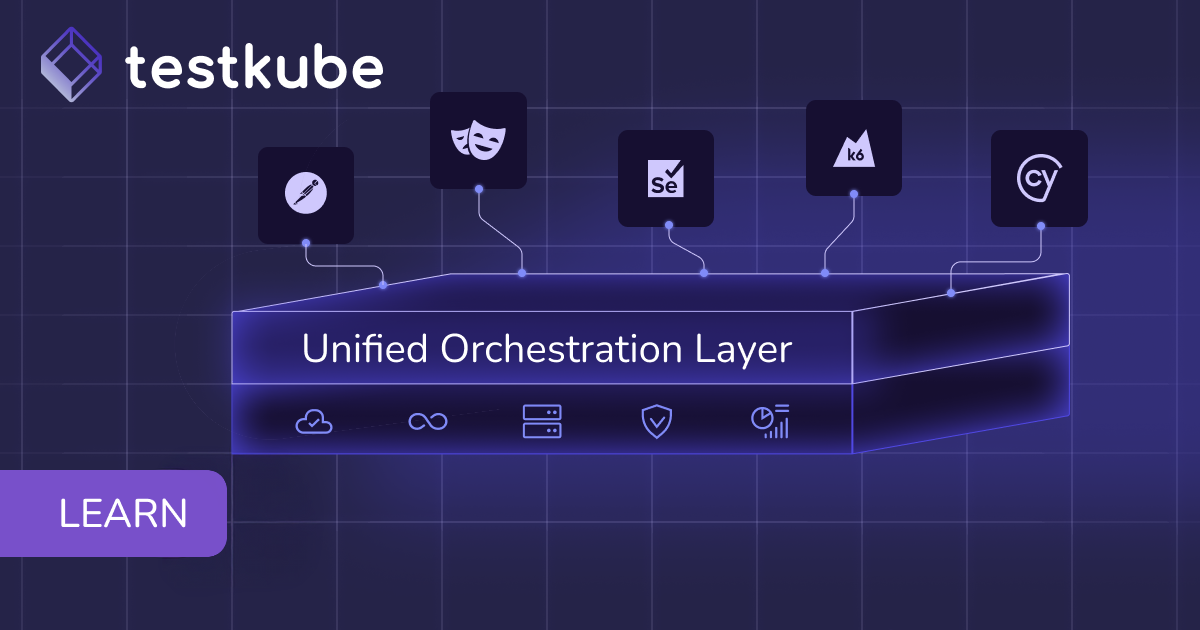
Testkube gives you a cloud-native, vendor-agnostic framework for orchestrating infrastructure tests directly inside your Kubernetes clusters. Rather than managing scattered scripts and tools, you define infrastructure validations as Test Workflows that run natively in Kubernetes with the tools your team already knows.
What you can orchestrate
- Combine curl, pytest, k6, and custom tools into a single multi-step infrastructure validation.
- Run tests at the points that matter: pre-deployment, post-upgrade, on a schedule, or as quality gates before critical releases.
- Execute tests inside your cluster for accurate results, without exposing infrastructure externally.
- Centralize results, logs, and artifacts in one dashboard, whatever tool or trigger started the test.
- Scale validation across clusters, environments, and geographies from a single control plane.
From workflow to quality gate
- Define your validation workflows in Testkube's Test Workflow format, combining familiar tools (curl for health checks, k6 for load, pytest for custom assertions) into sequenced or parallel steps.
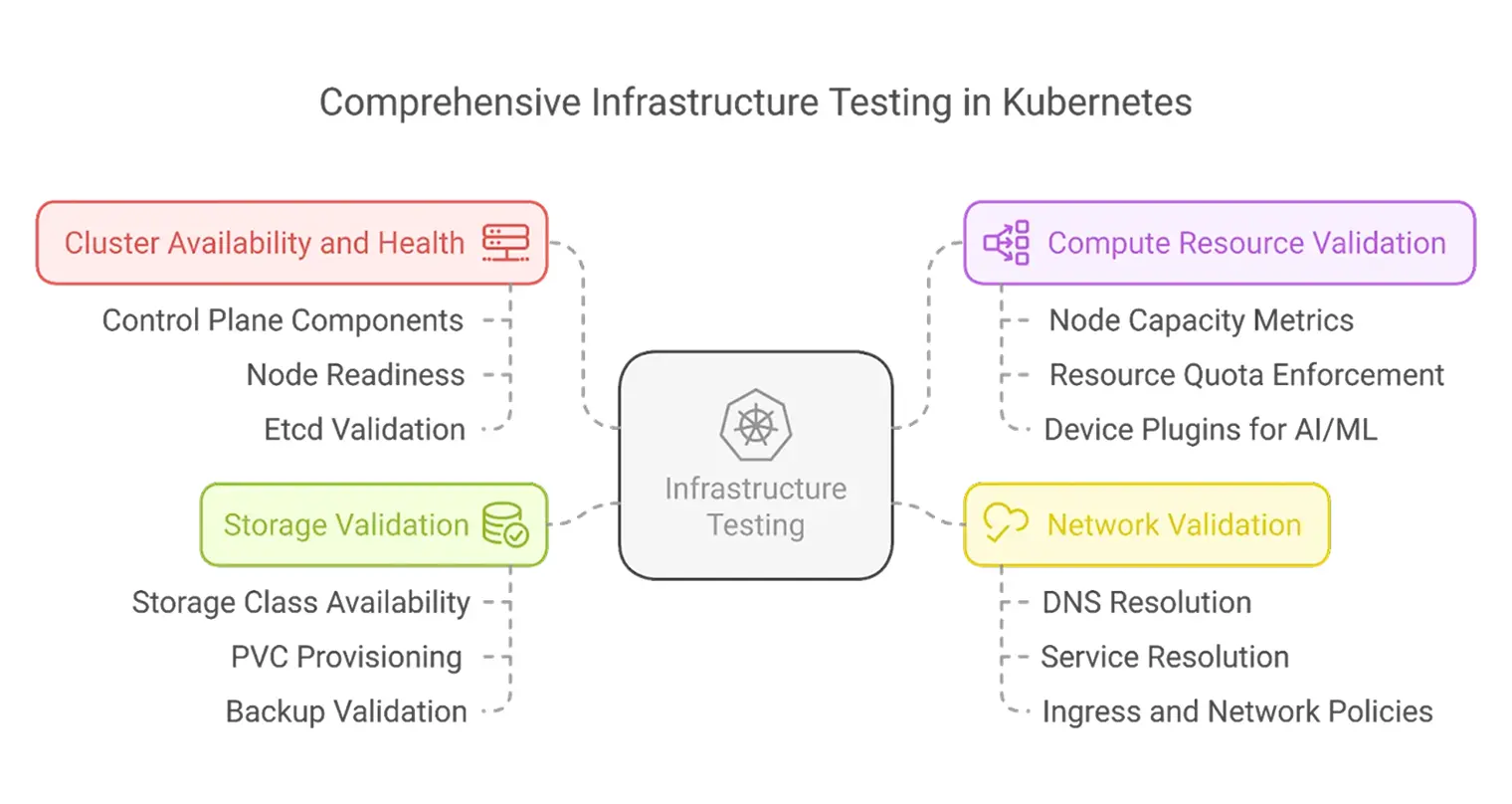
- Target specific infrastructure layers: cluster health (API server, etcd, CoreDNS), compute (CPU, memory, GPU availability), networking (DNS, ingress routing, network policies), and storage (PVC provisioning, I/O performance, backup integrity).
- Trigger tests where they matter, from CI/CD pipelines, on Kubernetes events via webhooks, on cron schedules, or manually before a critical deployment.
- Review results in one place. Logs and artifacts flow into the Testkube dashboard, where AI-assisted analysis can surface patterns and likely causes across failed checks.
- Act on findings. Use results as quality gates to block a deployment, trigger remediation, or flag configuration drift before it reaches production.
What you can validate
When to run these checks
- Pre-deployment, to validate cluster health before workloads go out.
- Post-provisioning, after infrastructure changes through Terraform or CloudFormation.
- Post-upgrade, to verify compatibility after a cluster upgrade.
- On a schedule, to catch configuration drift with regular runs.
- Before critical releases, as a pre-flight check ahead of high-impact workloads.
Before and after one framework
Why teams run this on Testkube
Traditional infrastructure testing means juggling multiple tools, custom integrations, and separate result aggregation, with each tool producing a different output format, running in a different environment, and storing results somewhere else. Testkube removes that fragmentation. Tests run as Kubernetes jobs inside your cluster, with access to internal services and real network conditions. You can use curl, k6, pytest, Postman, or any containerized tool without building custom integrations. Every result lands in one dashboard with log analysis, artifact storage, and historical comparison. And you can run the same validations across dev, staging, and production from one control plane, with Testkube acting as the gate that enforces infrastructure validation before a release proceeds.
Catch it before production
A deploy that succeeds is not the same as infrastructure that holds. Testkube lets you validate every layer of the cluster, in the cluster, with the tools you already use, so configuration problems surface before they reach a release.
Test faster, ship with confidence, and stay in control.
Run any test, anytime, anywhere
Curious how Testkube can support your team's testing strategy?
Fill out the form and we'll walk you through what's possible.