Table of Contents
Start your free trial.
Start your free trial.

Start your free trial.



Table of Contents
Executive Summary
Why AI-native teams are rethinking validation
Software delivery is no longer limited by how fast teams can write code, it's increasingly limited by how fast systems can validate change. In modern cloud-native environments, infrastructure updates, microservice deployments, configuration drift, and AI-generated code now move continuously through delivery pipelines.
As architectures become more distributed and deployment workflows more automated, traditional CI pipelines are being pushed far beyond what they were originally designed to handle. Long-running tests, environment dependencies, and orchestration complexity gradually turn validation into the slowest layer of software delivery.
In this post, we'll explore why traditional CI/CD models struggle in AI-native systems, how Continuous Testing extends and complements CI/CD, and why modern engineerin g teams need to rethink validation as a continuous operational capability rather than a pre-deployment checkpoint.
Why traditional CI pipelines struggle with AI native systems
Most CI pipelines were originally designed to automate code integration, build verification, and pre-deployment validation whenever changes were merged into shared repositories. While this model works well for many traditional applications, modern distributed systems introduce dynamic networking, ephemeral infrastructure, service dependencies, and runtime variability that cannot always be reproduced inside static CI runners. AI-native applications increase complexity because system behavior may change depending on prompts, retrieval pipelines, model versions, embeddings, or contextual inputs.
What CI/CD actually solves, and where it stops
CI/CD fundamentally changed software delivery by introducing automation, repeatability, and faster developer feedback loops. But as systems become increasingly distributed, cloud-native, and AI-driven, the limitations of pipeline-centric validation are becoming harder to ignore.
Problems CI/CD was designed to solve
Before CI/CD, software delivery relied heavily on manual builds, release coordination, environment setup, and deployment workflows that became increasingly difficult to manage as applications scaled. Continuous Integration improved this by automating builds, unit tests, packaging, and code validation whenever developers pushed changes into repositories. Continuous Delivery and Deployment further streamlined releases through automated artifact promotion, deployment orchestration, rollback mechanisms, and environment consistency.
Platforms such as GitHub Actions, GitLab CI/CD, and Jenkins helped engineering teams standardize release workflows while reducing operational overhead and deployment risk. Automated validation inside CI pipelines also gave developers faster feedback on build failures, code quality issues, and regressions during pull requests and merge stages. This model worked effectively for traditional applications where most failures could be detected before deployment and application behavior remained largely deterministic.
Where traditional CI/CD starts to break down
Pipelines become validation bottlenecks
Modern CI pipelines increasingly contain large integration suites, end-to-end tests, infrastructure provisioning logic, security checks, and environment orchestration workflows that significantly increase execution times. As applications and distributed services scale, centralized pipeline runners become bottlenecks where validation consumes more time than actual build and deployment stages. Instead of functioning as lightweight automation systems, pipelines gradually evolve into overloaded orchestration layers responsible for validation workloads they were never designed to handle efficiently.
Cloud-native applications are too dynamic for static pipelines
Cloud-native systems introduce runtime complexity that cannot always be validated effectively during pre-deployment stages. Infrastructure drift, service discovery behavior, autoscaling events, ephemeral workloads, and distributed networking conditions often emerge only after deployment or under production traffic conditions. Traditional CI pipelines were designed around static validation models and deterministic infrastructure assumptions, not around continuously validating highly dynamic distributed systems operating across constantly changing runtime environments.
What Continuous Testing means in modern cloud-native systems
Traditional testing strategies have historically been centered around pre-deployment validation, with most testing activities occurring during development and CI/CD pipeline execution. While post-deployment validation practices have existed for years , modern cloud-native and AI-native systems require a different approach where validation operates continuously across the entire software lifecycle, including runtime environments and production conditions.
Continuous Testing extends validation beyond CI pipelines
Continuous Testing treats validation as an always-running engineering capability rather than a single pipeline stage executed during pull requests or deployments. Testing can occur before or after deployment, during progressive delivery rollouts, after production releases, or continuously inside staging and production-like environments. This creates a more adaptive validation model that better reflects how modern distributed systems behave under real runtime conditions rather than static CI environments alone.
Validation becomes event-driven and runtime-aware
Modern testing systems increasingly trigger validations from Kubernetes events, GitOps synchronizations, infrastructure changes, feature flag rollouts, observability alerts, or runtime incidents instead of relying solely on Git commits. Runtime-aware validation allows engineering teams to continuously verify service health, API behavior, infrastructure stability, resiliency conditions, and performance across changing system states. Distributed execution models also allow testing workloads to scale independently from centralized CI runners, reducing pipeline bottlenecks and improving validation scalability across large cloud-native environments.
How Testkube fits into Continuous Testing architectures
As organizations move toward Continuous Testing models, validation systems must operate closer to runtime environments rather than remaining tightly coupled to centralized CI pipelines. This requires testing platforms like Testkube that are cloud-native, event-driven, scalable, and capable of orchestrating validation continuously across distributed infrastructure.
Testkube treats testing as a cloud-native capability
Testkube moves testing closer to where workloads actually run by orchestrating validation directly inside Kubernetes clusters. As we discussed in Decoupled Testing: The Future of Continuous Quality in Kubernetes, validation becomes significantly more effective when it runs closer to the applications and infrastructure being tested rather than inside isolated CI runners. By executing tests inside environment-aware and production-like conditions, teams can validate distributed services, networking behavior, and infrastructure dependencies under more realistic runtime conditions. This approach improves scalability, reduces environmental inconsistencies, and increases confidence for cloud-native applications operating across Kubernetes infrastructure.
Event-driven orchestration improves scalability
Testkube supports triggering tests from deployments, Kubernetes events, ArgoCD synchronizations, webhooks, schedules, and CI workflows, allowing validation systems to operate continuously across environments instead of only during pipeline stages. Distributed execution also enables teams to parallelize testing workloads independently from centralized CI runners, helping reduce orchestration bottlenecks that commonly slow large engineering organizations. Ephemeral execution environments further improve reliability by minimizing flaky tests caused by shared infrastructure dependencies and long-lived test environments.
Teams can unify multiple testing strategies
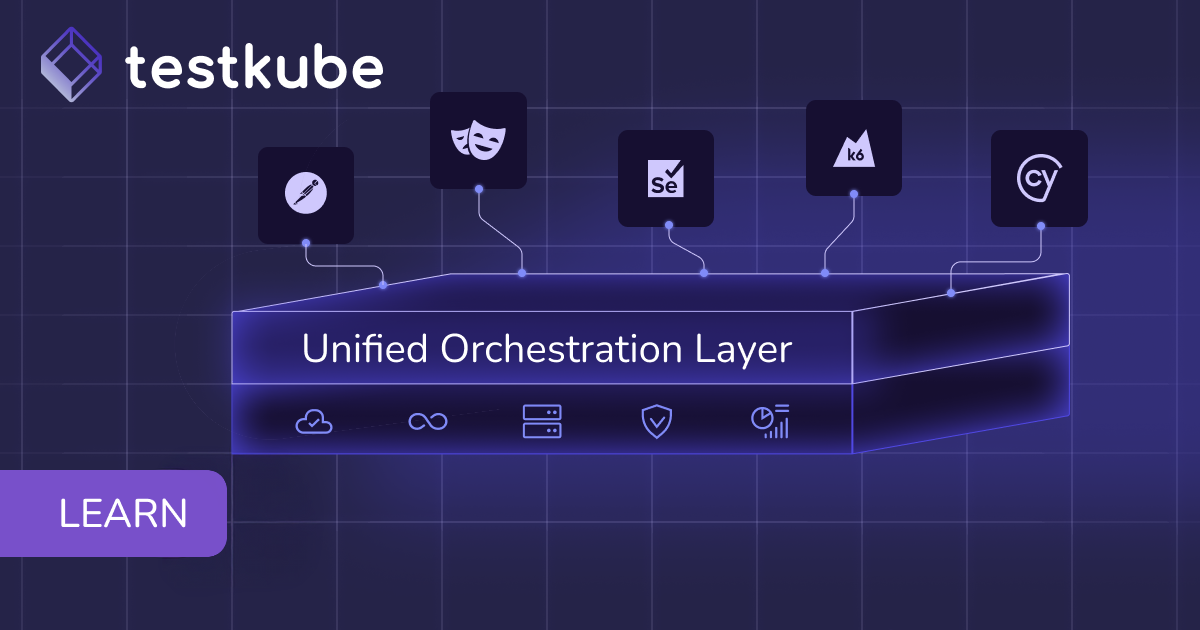
Modern engineering organizations rarely rely on a single testing framework, particularly in cloud-native systems where different application layers require different validation approaches. In Why Test Unification Is the Next Phase of Platform Engineering, we explored how platform teams can standardize orchestration without forcing engineering teams to abandon their preferred tools. Testkube supports frameworks including Playwright, Cypress, Postman, Pytest, k6, and JMeter, allowing teams to orchestrate API testing, end-to-end validation, performance testing, infrastructure verification, and resilience workflows from a unified platform. This enables platform teams to reduce operational complexity while still supporting diverse engineering requirements across services and teams.
Testkube AI Agents
As testing environments become increasingly distributed and operationally complex, engineering teams need better mechanisms for debugging, orchestration management, and validation intelligence across Kubernetes systems. In Where to Start with AI Agents in Testkube: A Practical Guide, we examined how AI Agents can assist with navigating this growing operational complexity. Testkube AI Agents help automate parts of the testing lifecycle by assisting with test generation, execution analysis, workflow recommendations, and troubleshooting across cloud-native validation environments. This helps reduce manual operational overhead while improving visibility into large-scale testing workflows running continuously across modern Kubernetes infrastructure.
The future of validation for AI-native platform teams
Modern software systems are becoming increasingly distributed, event-driven, and AI-powered, which is forcing engineering organizations to rethink how validation operates at scale. Testing is no longer just a development-stage activity; it is evolving into a continuous operational capability tightly connected to platform engineering, runtime observability, and system reliability.
Validation is becoming a platform engineering responsibility
High-performing engineering organizations are increasingly treating testing infrastructure as a reusable platform capability instead of maintaining isolated pipeline scripts across repositories and teams. Platform engineering groups are building centralized validation systems that can scale independently from deployment pipelines while supporting distributed cloud-native workflows across large environments. This shift improves standardization, reduces operational overhead, simplifies orchestration complexity, and enables faster feedback loops across engineering organizations operating at scale.
Runtime confidence is more important than deployment success
Successfully shipping code is no longer the final reliability milestone. Engineering teams also need confidence that systems continue behaving correctly after deployment under real-world runtime conditions. Continuous validation helps organizations detect infrastructure drift, service instability, latency degradation, AI regressions, networking failures, and operational anomalies before they impact production users. As systems become increasingly event-driven and AI-powered, runtime validation becomes a critical component of overall engineering reliability rather than simply a pre-deployment verification step.
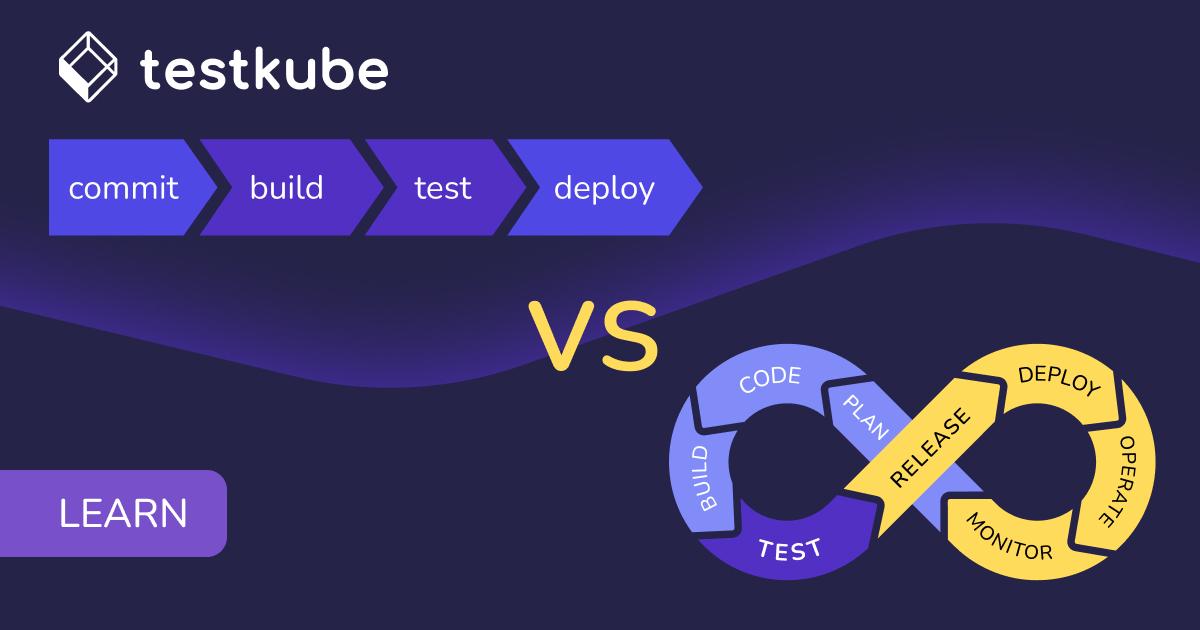
Continuous Testing complements CI/CD, it does not replace it
CI/CD remains essential for automating builds, deployments, and release orchestration across modern engineering environments. Continuous Testing extends that model by expanding validation across the full software lifecycle, including runtime environments and production conditions. Modern cloud-native systems require testing architectures that are distributed, Kubernetes-aware, event-driven, and capable of continuously validating both infrastructure behavior and application reliability. Organizations that invest in Continuous Testing architectures will be better positioned to scale engineering velocity without sacrificing operational stability or system confidence.
Conclusion
CI/CD remains essential for automating software delivery, but modern cloud-native and AI-native systems require validation that extends beyond pipeline execution. Continuous Testing enables teams to continuously verify application behavior, infrastructure reliability, and AI-system quality across the entire software lifecycle.
By moving validation closer to runtime environments and adopting event-driven testing models, organizations can scale delivery velocity without sacrificing reliability.
If you're looking to build scalable Continuous Testing workflows in Kubernetes, Testkube provides a cloud-native platform for orchestrating automated validation across environments, frameworks, and deployment workflows. Explore Testkube to see how platform teams are modernizing software validation for the AI-native era.
Frequently Asked Questions
About Testkube
Testkube is the open testing platform for AI-driven engineering teams. It runs tests directly in your Kubernetes clusters, works with any CI/CD system, and supports every testing tool your team uses. By removing CI/CD bottlenecks, Testkube helps teams ship faster with confidence.
Get Started with a trial to see Testkube in action.