Table of Contents
Start your free trial.
Start your free trial.

Start your free trial.



Table of Contents
Executive Summary
CircleCI is a solid CI/CD platform. It handles builds, runs tests in parallel containers, and deploys code. For teams working with straightforward application stacks, it does exactly what you need.
But if your infrastructure runs on Kubernetes and your testing needs have grown beyond what CI pipeline stages can handle, you have probably started noticing the friction. Tests run on CircleCI's cloud infrastructure, not in your clusters. Environment mismatch between CircleCI containers and your production pods introduces flaky results that waste debugging time. Credit-based pricing means your testing bill scales linearly with your test suite. And every test is coupled to a pipeline run, so you cannot trigger tests independently after a deployment, on a schedule, or on demand without workarounds.
CircleCI was designed to build, test, and deploy code through pipelines. It was not designed to orchestrate testing as an independent concern. Those are different problems.
This post covers eight alternatives for cloud-native teams that need testing to work natively with their infrastructure, not as a stage in someone else's pipeline. Some are direct CircleCI replacements for CI/CD. Others, like Testkube, are a different category entirely: a testing layer that works alongside whatever CI/CD tool you choose.
Want the broader case? Why CI pipelines and test orchestration are different jobs that deserve different tools. Read: Your CI pipeline is not a testing platform →
1. Testkube
Is Testkube a good CircleCI alternative? Not a direct replacement. Testkube handles test orchestration, not CI/CD builds and deployments. Most teams keep CircleCI (or another CI/CD tool) and add Testkube as a separate testing layer. Tests run as native Kubernetes jobs inside your clusters with environment parity, vendor-agnostic framework support, and predictable seat-based pricing.
Best for: Teams running Kubernetes in production that want to decouple test execution from CI/CD pipelines.
Testkube is a test orchestration platform that runs tests directly inside your Kubernetes clusters as native K8s jobs. Instead of embedding test logic into your CircleCI config.yml, you define test workflows in YAML, store them in Git, and execute them independently of any CI/CD tool.
The core difference from CircleCI: Testkube treats testing as its own concern, separate from CI/CD. It is not a CircleCI replacement. CircleCI (or whatever CI/CD tool you use) still handles builds and deployments. Testkube handles test execution, parallelization, reporting, and artifact collection. The two connect through triggers and webhooks, but neither depends on the other. Most teams that adopt Testkube keep their CI/CD tool and add Testkube as the testing layer.
CircleCI is a CI/CD platform built around pipeline stages. Scaling test execution means buying more credits for more containers. Testkube is a continuous testing platform built for cloud-native organizations, delivering reproducible test execution across clusters, unified testing workflows, real-time debugging, and test automation that works out of the box on your existing infrastructure.
Why Testkube over CircleCI for testing
Kubernetes-native execution with environment parity. CircleCI runs tests on managed containers in their cloud. Those containers do not match your production Kubernetes environment, which means tests that pass in CircleCI can fail in production (or worse, pass when they should fail). Testkube runs your tests as first-class Kubernetes workloads inside your actual clusters, using the same networking, service mesh, secrets, and resource constraints as your application. This eliminates the tests pass locally, fail in CI pattern at scale.
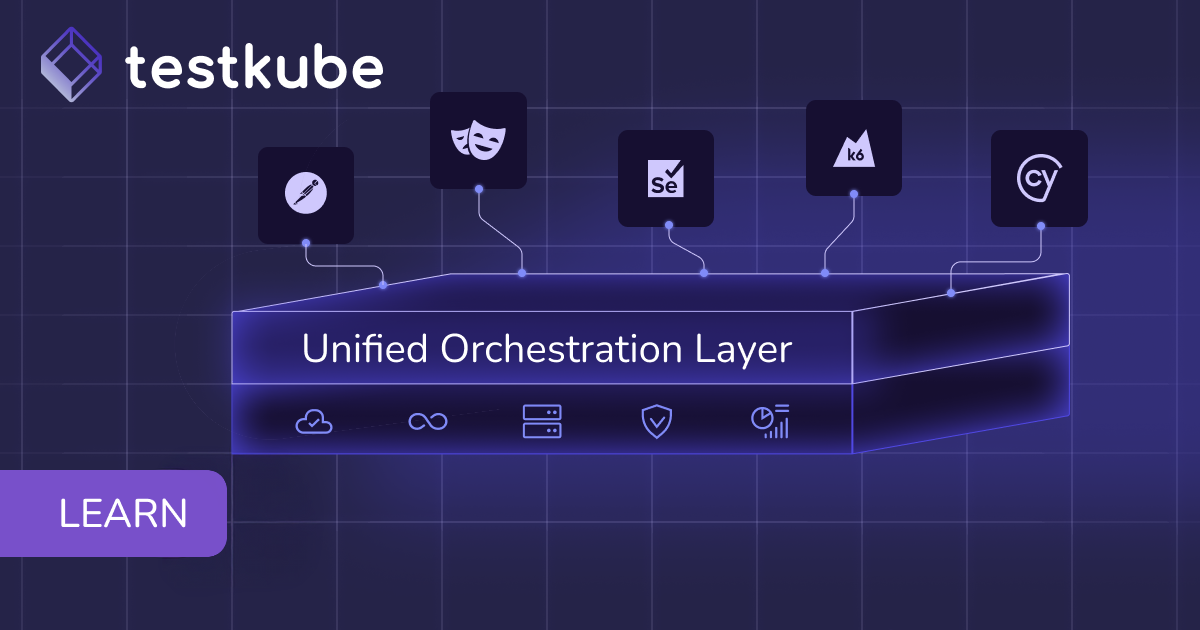
Vendor-agnostic testing for any framework. CircleCI supports multiple languages and executors, but testing capabilities are limited to what you can script into pipeline steps. Testkube is vendor-agnostic: Playwright, Cypress, Selenium, Postman, JMeter, k6, pytest, custom scripts. As long as it can be containerized, Testkube runs it inside your existing infrastructure as Kubernetes jobs.
Built-in observability and faster debugging. CircleCI provides job logs and basic test reporting through Orbs. Testkube maintains complete, searchable execution records with real-time logs, artifacts, pod events, and AI-assisted debugging, giving teams both a unified view of testing activities and faster troubleshooting across all test types and clusters.
Predictable pricing instead of credits. CircleCI charges per compute minute via credits. As your test suite grows and parallelism increases, costs scale proportionally. Testkube uses predictable seat-based pricing and runs on your existing Kubernetes infrastructure, which means no separate compute bill for test execution.
Designed for DevOps and GitOps workflows. Commit-based triggers, Git-based workflow definitions, ephemeral test environments, and multi-cluster deployments all work natively. Tests can be triggered by CI (CircleCI, Jenkins, GitHub Actions), CD (Argo CD or Flux), on a schedule, manually, based on Kubernetes events, or through AI agent workflows via MCP Server and the Testkube API.
Centralized results across the entire team. Results, logs, and artifacts are centralized in a single dashboard that everyone on the team can access, including QA, product, and engineering. DocNetwork reported that this visibility alone saved them 30 DevOps hours per week because they no longer needed weekly deployment coordination meetings.
Hybrid approach: CircleCI + Testkube
Many teams continue using CircleCI for CI but offload testing to Testkube. CircleCI triggers test workflows managed by Testkube, and Testkube handles execution, observability, scaling, and artifacts. Testkube integrates with CircleCI as well as GitHub Actions, GitLab CI, Jenkins, and Argo CD. The point is that switching CI/CD tools later does not mean rebuilding your entire testing setup.
Testkube vs CircleCI: Platform architecture
Testkube vs CircleCI: Testing capabilities
Testkube vs CircleCI: Developer experience
2. GitHub Actions
Is GitHub Actions a good CircleCI alternative? Yes for teams whose code already lives on GitHub. The marketplace ecosystem is large, integration with PRs and issues is tight, and basic test parallelization through matrix strategies works well. GitHub-hosted runners do not run in Kubernetes; self-hosted runners can but add operational overhead.
Best for: Teams already using GitHub that want CI/CD without managing separate infrastructure.
GitHub Actions is the default choice for teams whose code lives on GitHub. Workflows run on GitHub-hosted runners or self-hosted runners in your infrastructure. The marketplace has thousands of pre-built actions, and the integration with pull requests, issues, and releases is tight.
For testing, GitHub Actions handles the basics well. You can run tests in parallel using matrix strategies, cache dependencies to speed up runs, and get status checks directly on pull requests. See Jenkins vs GitHub Actions vs Testkube for the head-to-head comparison.
Trade-offs: GitHub-hosted runners do not run inside your Kubernetes clusters. Self-hosted runners can, but then you are managing runner infrastructure yourself, which is the operational overhead you may be trying to avoid. Testing is a pipeline stage, not an independent concern. If you need to run tests after a deployment, on a schedule, or triggered by Kubernetes events (not just code pushes), you are writing custom workflows. And if your team uses GitLab or Bitbucket, this is not an option.
3. GitLab CI/CD
Is GitLab CI/CD a good CircleCI alternative? Yes for teams using GitLab as their source control, especially those wanting integrated Kubernetes runners. Tests can execute as pods in your own cluster, which is closer to environment parity than CircleCI or GitHub's hosted runners. Still pipeline-coupled, not a separate testing layer.
Best for: Teams using GitLab for source control that want an integrated pipeline experience with Kubernetes runners.
GitLab CI/CD has a meaningful advantage over GitHub Actions for Kubernetes testing: you can run GitLab Runners inside your cluster. Tests execute as pods in your own infrastructure, which gets you closer to environment parity than either CircleCI or GitHub's hosted runners.
The Auto DevOps feature can detect your project type and generate a pipeline that includes testing, but most teams outgrow the auto-generated configuration quickly and end up writing custom .gitlab-ci.yml files anyway.
Trade-offs: GitLab CI/CD is still a pipeline tool, not a test orchestration tool. Test execution is tied to your pipeline stages. If you want to run tests on a schedule, after a deployment, or on demand without triggering a full pipeline, you are writing workarounds. The Kubernetes runner integration helps with where tests run but does not solve how tests are organized, reported, or scaled independently. If your team uses GitHub or Bitbucket for source control, GitLab CI/CD is not a practical option.
4. Tekton
Is Tekton a good CircleCI alternative? Yes for platform teams building custom Kubernetes-native CI/CD from the ground up. Pipelines are CRDs managed like any other Kubernetes resource. There are no native testing concepts (test suites, matrices, sharding, reporting), so the setup cost is real.
Best for: Platform teams building custom Kubernetes-native CI/CD from the ground up.
Tekton is an open-source framework for building CI/CD pipelines that run as Kubernetes-native resources. Tasks and pipelines are CRDs (Custom Resource Definitions), which means they are managed the same way as any other Kubernetes object.
For teams that want full control over their pipeline architecture, Tekton is genuinely powerful. You can build exactly what you need. Testkube actually integrates with Tekton for teams that want Kubernetes-native pipelines paired with purpose-built test orchestration.
Trade-offs: Tekton gives you building blocks, not a finished product. There are no native testing concepts: no test suites, no test matrices, no sharding, no built-in reporting. You are writing significant custom YAML and scripting to get test orchestration behavior that purpose-built tools provide out of the box. The maintenance burden is real. For teams with dedicated platform engineering resources, this can work. For teams that need to move fast, the setup cost is hard to justify.
5. Argo Workflows
Is Argo Workflows a good CircleCI alternative? Yes for teams already using Argo CD for GitOps that want workflow automation in Kubernetes. It handles DAGs, parallelism, retries, and artifact passing natively. Like Tekton, it has no concept of testing specifically; you build that on top.
Best for: Teams already using Argo CD for GitOps that want workflow automation in Kubernetes.
Argo Workflows is a Kubernetes-native workflow engine that defines workflows as CRDs. It handles DAGs (directed acyclic graphs), parallelism, retries, and artifact passing natively. If your team is already invested in the Argo ecosystem for deployments, Argo Workflows is a natural place to look for test automation.
It runs in your cluster, scales with Kubernetes, and integrates with the GitOps workflows your team likely already has in place.
Trade-offs: Argo Workflows is a general-purpose workflow engine. It does not know what a test is. There is no concept of test suites, test results, pass/fail reporting, or test-specific artifacts. You will build all of that on top of it. For teams running a handful of automation tasks, that is manageable. For teams with complex test matrices across multiple environments, the custom scripting required starts to look like maintaining an internal testing platform. At that point you are choosing between building the thing or buying the thing.
6. Buildkite
Is Buildkite a good CircleCI alternative? Yes for teams wanting a hybrid model where orchestration is managed but agents run on your own infrastructure. You get control over the execution environment without running a full CI/CD server. Still a CI/CD tool, not a testing platform.
Best for: Teams that want a hybrid model with managed orchestration and self-hosted agents.
Buildkite takes a different approach from CircleCI. The orchestration layer is cloud-hosted, but agents run on your own infrastructure. This gives you control over the execution environment while avoiding the overhead of managing a full CI/CD server.
For Kubernetes teams, you can run Buildkite agents inside your clusters. Tests execute on your hardware, with your networking, your secrets. Buildkite handles the scheduling, parallelism, and UI.
Trade-offs: Buildkite is a CI/CD orchestrator, not a testing platform. It does not have native test concepts like test suites, test reporting, or framework-specific integrations. You are scripting tests into pipeline steps, same as any CI/CD tool. The hybrid model is clever, but the operational burden of running agents in your clusters is still yours. Per-agent pricing can add up if you need significant parallelism. And the ecosystem of plugins is smaller than CircleCI's Orbs or GitHub's Actions marketplace.
7. Dagger
Is Dagger a good CircleCI alternative? Yes for teams that want to escape YAML and write pipeline logic in Go, Python, or TypeScript. The same pipeline runs on CircleCI, GitHub Actions, or your laptop. It solves pipeline portability, not Kubernetes-native testing.
Best for: Teams that want to define CI/CD pipelines as code using real programming languages instead of YAML.
Dagger lets you write your CI/CD pipeline logic in Go, Python, or TypeScript. Pipelines run in containers, and the same pipeline runs identically on your laptop, in CircleCI, in GitHub Actions, or anywhere else that can run containers.
The pitch is portability. If you are tired of being locked into CircleCI's config.yml syntax and want your pipeline logic to be genuinely portable across CI/CD providers, Dagger is worth a look.
Trade-offs: Dagger is a pipeline portability tool, not a testing platform. It solves the "my pipeline config is locked into one provider" problem, not the "my tests need to run inside Kubernetes" problem. There is no built-in test orchestration, reporting, or framework integration. The community is growing but still small compared to established CI/CD tools. And the learning curve is real: you are writing pipeline logic in a general-purpose language, which is more powerful but also more complex than YAML configuration.
8. Harness
Is Harness a good CircleCI alternative? Yes for enterprise teams wanting consolidated software delivery: CI, CD, feature flags, cloud cost management in one platform. The test intelligence feature can skip tests not affected by code changes. Still pipeline-coupled, not Kubernetes-native in the way Tekton or Testkube are.
Best for: Enterprise teams that want an all-in-one software delivery platform with AI-assisted pipelines.
Harness positions itself as a complete software delivery platform: CI, CD, feature flags, cloud cost management, and more. The CI module includes test intelligence features that analyze code changes and skip tests that are not affected, which can significantly reduce pipeline times.
For teams evaluating CircleCI alternatives at the enterprise level, Harness offers the kind of platform consolidation that procurement departments like: one vendor, one contract, multiple capabilities.
Trade-offs: Harness is a broad platform, which means each individual module competes with focused tools. The CI/CD is solid but not Kubernetes-native in the way Tekton or Testkube are. Tests still run as pipeline stages, not as independent Kubernetes workloads. The test intelligence feature is useful but works best with Java and a few other languages. Pricing is enterprise-tier, which puts it out of reach for smaller teams. And the breadth of the platform means you are buying capabilities you may not need.
Side-by-side comparison
Start here: Where do your tests need to run?
If the answer is "inside our Kubernetes clusters, in the same environment as production," your options are Testkube, Tekton, or Argo Workflows. Everything else runs tests outside your infrastructure (or requires you to manage self-hosted runners to get there).
Next: How much do you want to build versus buy?
If you have a dedicated platform engineering team and want full control over every piece of the testing pipeline, Tekton or Argo Workflows let you build exactly what you need. If you want test orchestration that works out of the box (reporting, parallelization, artifact collection, multi-framework support), Testkube provides that without the custom engineering.
Next: What types of tests are you running?
If your testing is mostly unit and integration tests tied to code pushes, a managed CI/CD tool like GitHub Actions or Buildkite handles that fine. If you need API testing, load testing, E2E testing, or a mix of all of these running in production-like environments, you need something broader.
Next: Do you want testing coupled to your pipeline or independent?
If you are fine with tests running as pipeline stages (and do not need on-demand, scheduled, or deployment-triggered test runs outside of CI/CD), GitHub Actions, GitLab CI/CD, or Buildkite work. If you need testing to operate as its own layer, decoupled from build pipelines, Testkube or Argo Workflows are the right fit.
How to choose
The right tool depends on what you are actually trying to solve.
If your primary pain is that CircleCI's credit-based pricing is getting expensive, Buildkite's per-agent pricing or Testkube's seat-based pricing may be better fits. GitHub Actions is effectively free for public repos and included in most GitHub plans.
If your primary pain is that tests do not run in the same environment as your application, and flaky results from environment mismatch are costing your team time, you need something Kubernetes-native. That narrows the list to Testkube, Tekton, and Argo Workflows.
If your primary pain is vendor lock-in to CircleCI's configuration format, Dagger lets you write portable pipeline logic in a real programming language. Your tests run the same way regardless of which CI/CD provider executes them.
If your primary pain is that testing is too tightly coupled to your CI/CD pipeline, and you want to run tests independently (on schedule, on demand, triggered by deployments, across environments), that is specifically what test orchestration is built for.
Most teams dealing with Kubernetes at scale end up needing some combination of these tools. A CI/CD platform handles builds and deployments. And a test orchestration layer manages test execution inside the cluster independently.
Key takeaways
- CircleCI alternatives split into two categories. Direct CI/CD replacements (GitHub Actions, GitLab CI/CD, Buildkite, Tekton, Argo Workflows, Dagger, Harness) handle builds and deployments. Test orchestration platforms like Testkube handle testing as a separate layer.
- Most Kubernetes teams keep both a CI/CD tool and add test orchestration. CircleCI (or its replacement) does what it does well. Testkube manages test execution, parallelization, and results inside the cluster.
- Environment parity is the structural difference. Tests sharing the same network, secrets, service mesh, and resource constraints as production stop producing false failures from infrastructure mismatch.
- Build-vs-buy depends on platform engineering capacity. Tekton and Argo Workflows give you building blocks if you have the team to assemble them. Purpose-built tools save the assembly cost.
- Different pain points map to different alternatives. Price → Buildkite or seat-based pricing. Environment parity → Testkube, Tekton, Argo Workflows. Configuration portability → Dagger. Enterprise consolidation → Harness.
Frequently asked questions
What are the best CircleCI alternatives for Kubernetes teams?
It depends on the problem you are solving. For Kubernetes-native CI/CD pipelines, Tekton and Argo Workflows are open-source options that run as CRDs in your cluster. For managed CI/CD with self-hosted runners, GitHub Actions, GitLab CI/CD, and Buildkite are direct competitors. For test orchestration specifically (separate from CI/CD), Testkube runs tests as native Kubernetes jobs alongside whatever CI/CD tool you keep.
Can I use Testkube with CircleCI instead of replacing it?
Yes. Many teams continue using CircleCI for builds and deployments but offload testing to Testkube. CircleCI triggers test workflows managed by Testkube, and Testkube handles execution, observability, scaling, and artifacts. You keep CircleCI for what it does well and add Testkube for test orchestration inside Kubernetes. Switching CI/CD tools later does not mean rebuilding your testing setup.
Why would I leave CircleCI if parallelism is already built in?
CircleCI's test splitting is useful but operates at the container level inside CircleCI's infrastructure. Tests do not run inside Kubernetes, so you miss environment parity with production. And every parallel container costs credits, so scaling parallelism scales your bill. Testkube parallelizes at the pod level inside your own clusters, using infrastructure you are already paying for.
How do tests run in Testkube vs CircleCI?
In Testkube, tests run as first-class Kubernetes workloads inside your clusters, using containers that match your production environment. Tests inherit your cluster's networking, service mesh, secrets, and resource constraints. In CircleCI, tests run on managed containers in CircleCI's cloud, with execution tied to pipeline jobs and limited by your credit tier.
Which CircleCI alternative supports the most testing frameworks?
Testkube is vendor-agnostic and supports any container-based tool: Playwright, Cypress, Selenium, Postman, JMeter, k6, pytest, custom scripts, and more. CircleCI supports frameworks through Orbs and Docker images, but each integration requires pipeline-level configuration. CI/CD-focused alternatives (GitHub Actions, GitLab CI/CD, Buildkite) handle frameworks via container images and custom scripting.
What if we are not on Kubernetes yet?
If your infrastructure is not on Kubernetes, Tekton and Argo Workflows are not the right fit. Testkube is optimized for Kubernetes but supports any containerized environment, so teams running Docker or other container runtimes can still use it. GitHub Actions, GitLab CI/CD, Buildkite, or Harness would also be good starting points as managed CI/CD platforms.
How do CircleCI costs compare to its alternatives?
CircleCI uses credit-based pricing where costs rise with parallelism and usage. GitHub Actions uses minutes-based pricing (often free for public repos). GitLab CI/CD is tier-based plus CI minutes. Buildkite uses per-agent pricing. Tekton and Argo Workflows are free and open-source but require operational overhead. Testkube uses predictable seat-based pricing and runs on infrastructure you already pay for.
About Testkube
Testkube is the open testing platform for AI-driven engineering teams. It runs tests directly in your Kubernetes clusters, works with any CI/CD system, and supports every testing tool your team uses. By removing CI/CD bottlenecks, Testkube helps teams ship faster with confidence.
Get Started with a trial to see Testkube in action.