Table of Contents
Start your free trial.
Start your free trial.

Start your free trial.



Table of Contents
Executive Summary
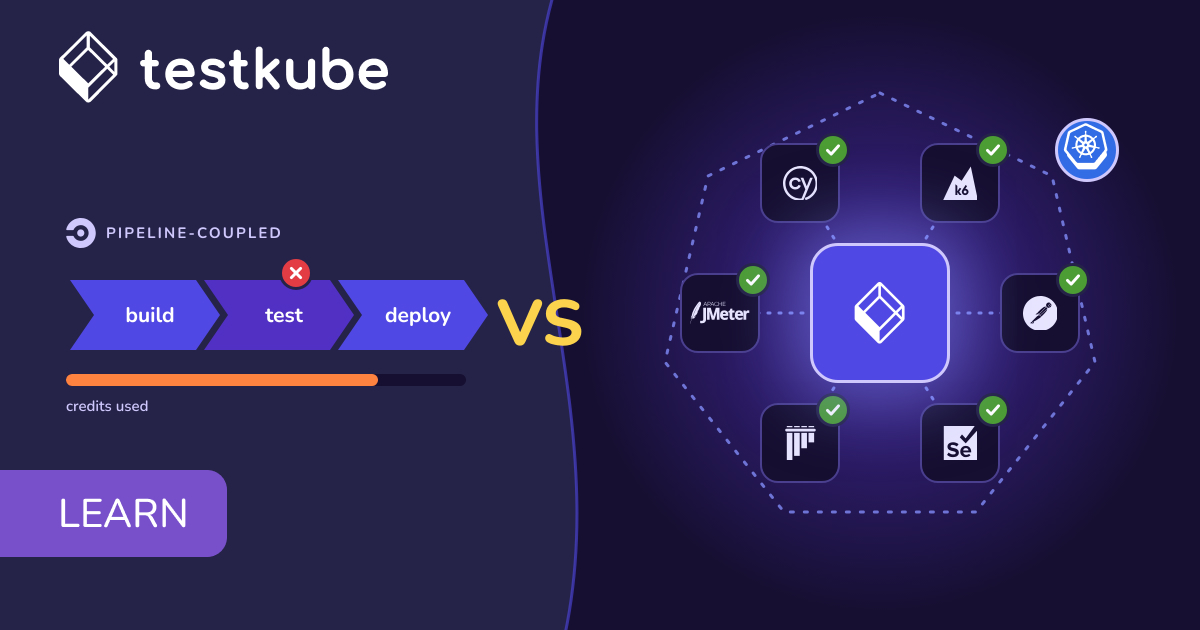
The main GitLab CI alternatives in 2026 are GitHub Actions, Jenkins, CircleCI, Buildkite, Tekton, Argo Workflows and Harness. Any of them can replace GitLab CI as your CI/CD system. Testkube, the eighth option, works differently: you keep GitLab CI for builds and deployments, and Testkube runs your tests as Kubernetes jobs inside your own clusters.
Teams usually start looking when one of four things happens. The bill grows with seats and compute minutes. The .gitlab-ci.yml files get too long for anyone but their author to follow. Keeping runners healthy turns into a part-time job. Or tests need to run on events a pipeline doesn't know about, like a deployment finishing in the cluster.
This post compares the eight options on where jobs run, how they handle tests and how they charge. It also shows a working GitLab CI and Testkube setup, using the YAML from our docs.
Why teams look for GitLab CI alternatives
Cost. GitLab prices CI into its seats. As of November 2026, the Free tier includes 400 compute minutes a month for up to 5 users per top-level group, and Premium costs $29 per user a month, billed annually, with 10,000 compute minutes (GitLab pricing). Large test suites on GitLab-hosted runners use those minutes quickly. Running your own runners avoids the minutes, but then the runners are your job.
Pipeline sprawl. Test logic ends up in .gitlab-ci.yml: stages, rules, needs, parallel matrices, artifact and report paths. It works, but the pipeline file becomes the only place that knows how to run a suite, and anyone who doesn't edit it every week has to ask how it works.
Runner upkeep. To run jobs in Kubernetes, you install GitLab Runner with the Kubernetes executor, which creates a pod for each CI job (GitLab docs). That puts jobs in your cluster, but sizing, autoscaling, caching and upgrades are on you.
Tests tied to pipelines. Tests run when a pipeline runs. Running the same suite against several environments, after an Argo CD sync, or on request from someone outside the pipeline usually means writing more pipeline code. If you're moving source control to GitHub anyway, keeping CI in GitLab rarely makes sense either.
1. Testkube: keep GitLab CI, run tests in your cluster
Is Testkube a GitLab CI alternative? Not a replacement. Testkube is a test orchestration platform, so GitLab CI keeps building and deploying your code. Testkube takes over test execution: tests run as Kubernetes jobs in your own clusters, and results, logs and artifacts from every run land in one dashboard.
Best for: Teams staying on GitLab that want testing out of pipeline YAML and inside the clusters where their services run.
You define tests as Test Workflows, YAML custom resources that you store in Git. A workflow can run from a CI job, the CLI, the API, a schedule or a Kubernetes event. Testkube runs any tool that fits in a container, including Playwright, Cypress, k6, JMeter, Postman and pytest, and keeps the logs and artifacts from each run.
Your GitLab pipeline gets shorter. One job calls a workflow with the Testkube CLI, and the workflow runs in the cluster. If you change CI tools later, the workflows stay the same, because they don't live in the pipeline. Pricing isn't based on compute minutes, since tests run on infrastructure you already pay for (Testkube pricing).
Trade-offs: Testkube doesn't build or deploy code, so you still need a CI/CD tool. It needs a Kubernetes cluster for its runner. And it's a second tool to manage, which pays off once testing has outgrown pipeline stages, not before.
What a GitLab CI and Testkube setup looks like
The setup below comes from the Testkube GitLab CI docs. It has two parts: a Test Workflow that lives in your cluster, and a short GitLab job that runs it.
Step 1: the Test Workflow. This example from the Playwright example in our docs clones a Playwright project, installs dependencies and runs the tests in a pod that requests 2 CPUs and 2Gi of memory. It saves the Playwright HTML report as an artifact.
apiVersion: testworkflows.testkube.io/v1
kind: TestWorkflow
metadata:
  name: playwright-sample
  namespace: testkube
  labels:
    docs: example
spec:
  content:
    git:
      uri: https://github.com/kubeshop/testkube
      revision: main
      paths:
      - test/playwright/playwright-project
  container:
    workingDir: /data/repo/test/playwright/playwright-project
    image: mcr.microsoft.com/playwright:v1.32.3-focal
    resources:
      requests:
        cpu: 2
        memory: 2Gi
  steps:
  - name: Install dependencies
    shell: npm ci
  - name: Run tests
    shell: npx --yes playwright@1.32.3 test --trace on
    artifacts:
      paths:
      - playwright-report/**/*
Step 2: the GitLab job. Store TESTKUBE_API_KEY, TESTKUBE_ORG_ID and TESTKUBE_ENV_ID as CI/CD variables in GitLab instead of writing them into the file. The job uses the kubeshop/testkube-cli image, sets the Testkube context and runs the workflow. Replace TEST_WORKFLOW_NAME with your workflow's name, such as playwright-sample.
stages:
  - setup

setup-testkube:
  stage: setup
  image:
    name: kubeshop/testkube-cli
    entrypoint: ["/bin/sh", "-c"]
  script:
    - testkube set context --org-id $TESTKUBE_ORG_ID --env-id $TESTKUBE_ENV_ID -c cloud -k $TESTKUBE_API_KEY
    - testkube run testworkflow TEST_WORKFLOW_NAME -f
GitLab still decides when tests run, for example on every merge request. The run itself happens in your cluster, next to the services under test, and the results stay in Testkube with the history of every earlier run. The same docs page covers connecting to EKS and GKE clusters, and to the open source edition of Testkube with a kubeconfig.
2. GitHub Actions
Is GitHub Actions a good GitLab CI alternative? Yes, if your code is on GitHub or moving there. Running CI where your code lives keeps merge checks, permissions and history in one place.
Best for: Teams whose source control lives on GitHub.
Workflows run on GitHub-hosted runners or on your own. For Kubernetes, Actions Runner Controller (ARC) is a Kubernetes operator that runs and autoscales self-hosted runners in your cluster (ARC on GitHub). The Marketplace covers most build and test steps, and matrix jobs handle basic parallel testing. Our Jenkins vs GitHub Actions comparison goes deeper on Actions.
Pricing moved this year. GitHub cut hosted-runner prices by up to 39% on January 1, 2026, and postponed a planned charge for self-hosted runner usage (GitHub).
Trade-offs: Leaving GitLab means rewriting each .gitlab-ci.yml as a workflow file, plus moving issues, merge requests and permissions if source control moves too. Hosted runners don't run in your cluster. ARC does, but you run and upgrade it. Tests are still pipeline steps.
3. Jenkins
Is Jenkins a good GitLab CI alternative? Yes, if you want an open source CI server that you host and control completely, and you have people to run it.
Best for: Teams with strict self-hosting requirements and existing Jenkins skills.
Jenkins is an open source automation server with hundreds of plugins (jenkins.io). Its Kubernetes plugin starts a pod for each agent and stops it after the build (Kubernetes plugin), so builds and tests can run in your cluster.
Trade-offs: You host, patch and back up the controller, and keeping plugins compatible is your problem. Jenkinsfiles tend to grow the same way .gitlab-ci.yml files do. If you're weighing Jenkins against newer tools, our Jenkins alternatives post covers the other direction.
4. CircleCI
Is CircleCI a good GitLab CI alternative? Yes, if you want a managed CI service that's quick to set up and you're comfortable with usage-based billing.
Best for: Teams that want hosted CI with strong caching and parallelism and don't want to run servers.
CircleCI runs jobs in its own cloud by default. Its container runner runs jobs in your Kubernetes cluster instead and is configured through a Helm chart (CircleCI docs). As of November 2026, the Free plan covers up to 6,000 build minutes and 5 active users, and paid plans start at $15 a month, with usage billed in credits (CircleCI pricing).
Trade-offs: Credit billing grows with parallelism, so bigger test suites cost more. CircleCI connects to GitLab repositories, but you give up GitLab's single place for code, CI and issues. Our CircleCI alternatives post compares it with the rest of this list.
5. Buildkite
Is Buildkite a good GitLab CI alternative? Yes, if you want a hosted control plane while every job runs on your own infrastructure.
Best for: Teams with large or complex builds that want to own their compute.
Buildkite hosts the UI and scheduling, and you run the agents. The Agent Stack for Kubernetes is a controller that watches your queue and runs each job as a Kubernetes pod (Buildkite docs). Dynamic pipelines let a build generate its next steps at runtime. As of November 2026, the Free plan covers up to 5 users, and Pro costs $30 per active user a month (Buildkite pricing).
Trade-offs: You run and scale the agents. Buildkite doesn't host code, so you pair it with GitLab, GitHub or Bitbucket. Tests are still steps in a pipeline.
6. Tekton
Is Tekton a good GitLab CI alternative? Yes, for platform teams that want to build their own Kubernetes-native CI/CD from parts.
Best for: Platform engineering teams with time to assemble and maintain a pipeline system.
Tekton is a set of Kubernetes custom resources for Tasks, Pipelines and their runs, and each Task runs as its own pod (Tekton docs). It's open source and a CNCF incubating project, so there's no license cost.
Trade-offs: Tekton gives you building blocks, not a finished product. Triggers, dashboards, secrets handling and test reporting are yours to put together. Testing concepts like suites, sharding and flaky-test tracking aren't included.
7. Argo Workflows
Is Argo Workflows a good GitLab CI alternative? Partly. It's a strong fit if you already run Argo CD and want workflows and DAGs that run natively in the cluster, but it isn't a CI system on its own.
Best for: Teams already invested in the Argo ecosystem.
Argo Workflows is a workflow engine implemented as a Kubernetes CRD (Argo Workflows). It handles DAGs, parallel steps, retries and artifacts, and it's part of the Argo project, a CNCF graduated project.
Trade-offs: You need something else to react to Git events, such as Argo Events, or GitLab CI kept as the trigger. Argo Workflows doesn't know what a test is, so results, history and reporting are yours to build. We compare the two in Testkube vs Argo Workflows.
8. Harness
Is Harness a good GitLab CI alternative? Yes, for enterprises that want CI, CD and other delivery tools from one vendor.
Best for: Large organizations consolidating delivery tooling under one contract.
Harness CI runs builds on Kubernetes, VMs, bare metal or Harness Cloud. Its Test Intelligence feature selects only the tests affected by a code change (Harness CI). Harness lists a Free plan, and its Essentials and Enterprise plans are priced through sales (Harness pricing).
Trade-offs: Pricing is quote-based, which makes it hard to compare up front. The platform is broad, which pays off only if you use several modules. Tests still run as pipeline stages.
Side-by-side comparison
Pricing reflects each vendor's public pricing page as of November 2026.
How to choose a GitLab CI alternative
Start with the problem you're trying to fix, not the feature lists.
Your code is moving to GitHub. Choose GitHub Actions. Running CI on a different platform from your code adds work without much in return.
You need everything self-hosted with no license cost. Choose Jenkins if you want a finished CI server. Choose Tekton or Argo Workflows if you want Kubernetes-native building blocks and have a platform team to assemble them.
You want managed scheduling but your own compute. Choose Buildkite, or CircleCI with its container runner.
You want one enterprise vendor for delivery. Choose Harness.
GitLab works for builds, and the pain is testing. Keep GitLab CI and add Testkube. Rewriting every pipeline to fix a testing problem is the expensive way to fix it.
A quick check: write down the last five problems your team had with GitLab CI. If most are about builds, deployments or cost, a different CI tool may be the answer. If most are about slow, flaky or hard-to-run tests, the CI tool probably isn't the part to replace.
Frequently asked questions
{{banner-get-started}}
About Testkube
Testkube is the open testing platform for AI-driven engineering teams. It runs tests directly in your Kubernetes clusters, works with any CI/CD system, and supports every testing tool your team uses. By removing CI/CD bottlenecks, Testkube helps teams ship faster with confidence.
Get Started with a trial to see Testkube in action.