Table of Contents
Start your free trial.
Start your free trial.

Start your free trial.



Table of Contents
Executive Summary
Jenkins and GitHub Actions are two of the most common ways teams run tests today. Jenkins does it through pipeline stages on self-managed infrastructure. GitHub Actions does it through workflow steps on managed runners. Both embed testing inside CI/CD pipelines as part of the build-and-deploy process. Teams running into this often realize they are doing test orchestration already, just badly, with whatever tool happened to be nearby.
Testkube is in this comparison because it answers a different question. Instead of "how do I run tests inside my CI/CD pipeline," Testkube asks "what if testing was its own thing, separate from the pipeline, running natively inside Kubernetes?" It is not a CI/CD tool. It does not replace Jenkins or GitHub Actions for builds and deployments. It replaces the testing stage with something purpose-built.
If you are evaluating these three, you are probably trying to decide whether testing should stay embedded in CI/CD or become its own independent layer. This page helps you think through that decision.
Want a broader view? Explore eight Jenkins alternatives for Kubernetes testing, including Tekton, Argo Workflows, and CircleCI. Read: 8 Jenkins Alternatives for Kubernetes Testing →
The short version
Is Testkube a replacement for Jenkins or GitHub Actions? No. Jenkins is a self-hosted CI/CD server. GitHub Actions is a cloud-hosted CI/CD platform tied to GitHub. Both can run tests as pipeline or workflow steps. Testkube is a Kubernetes-native test orchestration platform that runs tests independently of any CI/CD tool. It works alongside Jenkins or GitHub Actions, not instead of them.
The real question is not "which one is better at testing" but "should testing be a pipeline stage or an independent platform?"
Jenkins: Deep dive
Is Jenkins a good fit for testing in Kubernetes? Jenkins is a mature, flexible CI/CD automation server. It runs tests well at small scale, but was not designed for test orchestration. Teams running hundreds of tests across Kubernetes environments typically outgrow what Jenkins agents can handle.
Jenkins is an open source CI/CD automation server that has been around since 2011 (forked from Hudson). It is self-hosted, extensible through plugins, and can be configured to do almost anything. For many teams, Jenkins is where test automation started.
What Jenkins does well
Extreme flexibility. Jenkins can be configured to run virtually any workflow. The plugin ecosystem (1,800+ plugins) covers nearly every tool, language, and integration you might need. If a workflow exists, Jenkins can probably automate it.
Self-hosted control. You control the infrastructure, the configuration, and the data. For organizations with strict security requirements, this level of control matters. Jenkins agents can run on VMs, bare metal, or inside Kubernetes clusters.
Mature and well-understood. Jenkins has been in production for over a decade. The community is large, documentation is extensive, and most DevOps engineers have worked with it. Hiring people who know Jenkins is not difficult.
Where Jenkins falls short for testing
Tests are pipeline stages, not independent concerns. Test logic lives inside Jenkinsfiles alongside build and deploy logic. Tests cannot be triggered independently of a pipeline run without workarounds. You cannot easily run the same test suite on a schedule, after a deployment, or on demand without creating separate pipeline configurations.
Plugin sprawl and maintenance burden. Every testing framework integration requires plugins. Plugins conflict, lag behind updates, and introduce maintenance overhead. The Groovy-based pipeline DSL adds a scripting layer that often becomes an expertise silo on the team.
Scaling is manual. Running tests in parallel requires pre-provisioned agents or complex cloud agent configurations. Jenkins was designed for VM-era workloads, not for elastic scaling on Kubernetes. The Kubernetes plugin helps, but it adds configuration complexity.
Test reporting is limited. Jenkins provides basic pass/fail results and JUnit XML parsing. Cross-pipeline test visibility, artifact management, and historical trend analysis require additional plugins or external tools. Test results can be deleted when builds are cleaned up.
Environment mismatch. Tests run on Jenkins agents, which may not match your production Kubernetes environment. Networking, secrets, service discovery, and resource constraints are all different unless you invest significant effort in making agents match production. This is a common cause of tests that pass locally but fail in CI.
Want the full Testkube vs Jenkins breakdown? Side-by-side comparison of architecture, testing capabilities, and developer experience. Read: Testkube vs Jenkins →
GitHub Actions: Deep dive
Is GitHub Actions a good fit for testing in Kubernetes? GitHub Actions is a strong CI/CD tool for teams already on GitHub, especially for small to medium test suites. It is not Kubernetes-native: tests run on managed runners outside your cluster, so environment parity and data sovereignty are limitations.
GitHub Actions is a CI/CD platform built into GitHub. Workflows are defined in YAML, triggered by GitHub events, and executed on managed runners or self-hosted runners.
What GitHub Actions does well
Tight GitHub integration. If your code lives on GitHub, the integration is unmatched. Status checks on pull requests, automated workflows triggered by issues, releases, and schedules. The developer experience for simple CI/CD is hard to beat.
Managed infrastructure. GitHub-hosted runners eliminate the operational overhead of maintaining CI servers. You do not provision agents, patch servers, or manage capacity. For teams that want to stop thinking about CI infrastructure, this is the primary appeal.
Marketplace ecosystem. Thousands of pre-built actions for common tasks. Setting up a test workflow with caching, matrix strategies, and artifact uploads can be done in an afternoon.
Matrix strategies for parallelism. You can run tests across multiple OS, language, and browser combinations using matrix strategies. The syntax is clean and well-documented.
Where GitHub Actions falls short for testing
Tests are workflow steps, still coupled to CI/CD. Like Jenkins, testing is embedded in the CI/CD workflow. Running tests independently of a code push (after a deployment, on a schedule, triggered by a Kubernetes event) requires custom workflow configurations. Testing is not treated as its own concern.
GitHub-hosted runners are not your environment. Tests run on Ubuntu, Windows, or macOS VMs managed by GitHub. These do not match your Kubernetes production environment. Self-hosted runners can run inside your cluster, but then you are managing runner infrastructure yourself.
Limited test-specific features. No native test suites, test reporting dashboards, or framework-specific integrations. You get job logs and artifacts. Anything beyond that requires third-party actions or external tools.
GitHub lock-in. If your code is on GitLab, Bitbucket, or any other provider, GitHub Actions is not an option. Migrating workflows to another CI/CD tool means rewriting YAML from scratch.
Minutes-based pricing at scale. The free tier is generous for open source and small teams. For private repos with large test suites, minutes-based pricing adds up, especially with matrix strategies that multiply runner usage.
Already running Jenkins or GitHub Actions? Layer Testkube on top with the native plugin or GitHub Actions integration. The migration is incremental.
Testkube: Deep dive
Is Testkube a CI/CD tool? No. Testkube is a test orchestration platform that runs tests inside your Kubernetes clusters as native K8s jobs. It does not handle builds or deployments. It handles testing as an independent concern that connects to whatever CI/CD tool you use.
What Testkube does well
Testing as an independent layer. Tests are defined as test workflows in YAML, stored in Git, and triggered independently of CI/CD pipelines. You can trigger tests from Jenkins, GitHub Actions, GitLab CI, Argo CD, on a schedule, manually, via API, based on Kubernetes events, or through AI agent workflows via MCP Server. If you switch CI/CD tools tomorrow, your testing setup does not change.
Kubernetes-native execution. Tests run as first-class Kubernetes workloads inside your clusters. Same networking, same service mesh, same secrets, same resource constraints as your application. No environment mismatch. No agents to configure. Tests scale with your cluster.
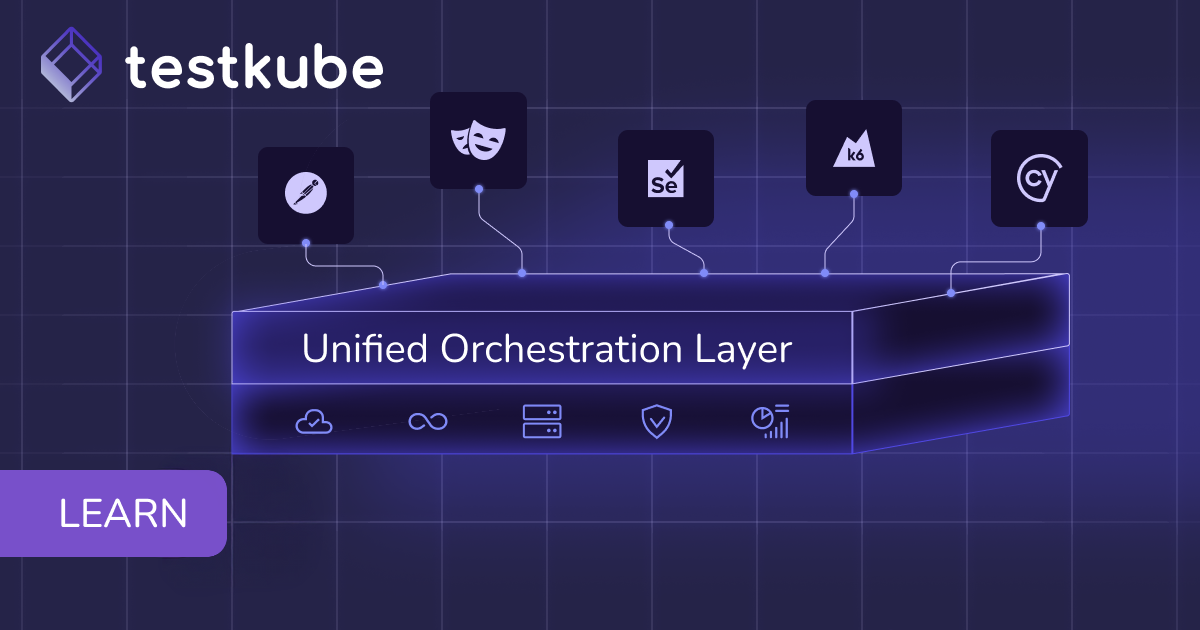
Every test type, one control plane. Playwright, Cypress, Selenium, Postman, JMeter, k6, pytest, custom scripts. Testkube orchestrates all of them. Instead of separate pipeline stages for unit tests, integration tests, load tests, and E2E tests (each with their own configuration and reporting), you get a single orchestration layer.
Built-in observability. Real-time logs, artifacts, pod events, AI-assisted debugging, and centralized reporting across all test types and clusters. DocNetwork saved 30 DevOps hours per week from centralized test visibility alone. TomTom uses Testkube across development, testing, acceptance, and production environments with integrated Prometheus monitoring.
Predictable pricing. Seat-based pricing on your existing infrastructure. No per-minute charges, no credit tiers, no cost spikes when you add more tests. See pricing.
Where Testkube is not the right fit
It does not do CI/CD. Testkube does not build code, create artifacts, or deploy applications. You still need Jenkins, GitHub Actions, or another CI/CD tool for those jobs. Testkube is the testing layer that sits alongside your CI/CD, not a replacement for it.
Optimized for containerized environments. Testkube runs most powerfully as native Kubernetes workloads but also supports Docker-based execution. Teams that are not fully on K8s yet can still use Testkube, though the deepest advantages (environment parity, pod-level scaling, CRD-based workflows) come from running in K8s. For teams weighing whether to adopt Kubernetes, the testing layer is often one of the first places the trade-off shows up.
Additional tool to manage. Adding Testkube means introducing another platform into your stack. For teams with small test suites that run fine as pipeline stages, the added complexity may not be justified. Testkube makes the most sense when testing has grown complex enough that embedding it in CI/CD creates more problems than it solves.
Feature-by-feature comparison
Testing capabilities
Operations and maintenance
The real decision: Pipeline-embedded vs independent testing
This comparison is not really about picking one tool. Jenkins and GitHub Actions are CI/CD tools. Testkube is a testing platform. Most teams that adopt Testkube keep their CI/CD tool and add Testkube as the testing layer.
The real question is: has your testing complexity outgrown what CI/CD pipeline stages can handle?
The hybrid approach most teams end up with
Jenkins or GitHub Actions handles builds and deployments. Testkube handles test execution. The CI/CD tool triggers Testkube test workflows, and Testkube handles orchestration, parallelization, reporting, and artifacts inside Kubernetes. Testkube has a native Jenkins plugin and a GitHub Actions integration for exactly this pattern. There is no T (testing) in CI/CD. That is the gap Testkube fills.
For a deeper walkthrough of this pattern with Jenkins specifically, see improving test automation in Jenkins using Testkube.
Key takeaways
- This is not really a three-way comparison. Jenkins and GitHub Actions are CI/CD tools. Testkube is a test orchestration platform. The real decision is whether testing should be a pipeline stage or its own independent layer.
- Pipeline-embedded testing works at small scale. If your suite runs in under 15 minutes, uses one or two frameworks, and runs fine on code push, Jenkins or GitHub Actions handles testing fine as part of the pipeline.
- Independent test orchestration earns its keep when testing complexity grows. Long suites, multiple frameworks, environment mismatch, scattered results, tests that need to run outside of code pushes. These are the signals testing has outgrown what CI/CD can handle.
- Most teams running Kubernetes end up with both. Jenkins or GitHub Actions for builds and deployments. Testkube for test execution inside the cluster. Native plugins make the integration straightforward.
- Switching CI/CD tools should not mean rebuilding your testing setup. When tests are defined as Testkube workflows, they stay stable while the CI/CD trigger changes. TomTom transitioned from Azure DevOps to GitHub Actions while keeping Testkube as the test orchestration layer.
Frequently asked questions
Is Testkube a Jenkins or GitHub Actions replacement?
No. Testkube does not handle builds or deployments. It replaces the testing stage of your pipeline with a purpose-built orchestration layer. Most teams keep Jenkins or GitHub Actions for CI/CD and add Testkube for testing. Testkube integrates with both through native plugins.
When should I just use GitHub Actions for everything?
If your team uses GitHub, your test suite is small to medium, your infrastructure is not Kubernetes-based, and you do not need tests to run independently of code pushes, GitHub Actions handles testing fine as workflow steps. The limitations show up when testing grows complex: multiple frameworks, long suites, environment mismatch causing flaky results.
When should I just use Jenkins for everything?
If Jenkins agents run your suite fine and plugin maintenance is manageable, there is no reason to change. The pain points that lead teams to add Testkube are test suites outgrowing agent capacity, pipeline logic that is half test configuration, scattered results with no central view, and tests that need to run in Kubernetes but Jenkins agents do not match the cluster environment.
Can I try Testkube alongside my existing setup?
Yes. Testkube installs into your Kubernetes cluster via Helm. You can start by moving one test suite (like load tests or E2E tests) from your CI/CD pipeline into Testkube and triggering it from your existing Jenkins or GitHub Actions workflow. The migration can be incremental.
How does TomTom use Testkube with CI/CD?
TomTom integrated Testkube across development, testing, acceptance, and production environments. They started by migrating Azure DevOps pipeline-triggered tests into Testkube, running SoapUI, JMeter, and Selenium tests. They are transitioning to GitHub Actions as their CI trigger while keeping Testkube as the test orchestration layer. Their testing setup stays stable regardless of which CI/CD tool triggers it.
How do the costs of Jenkins, GitHub Actions, and Testkube compare?
Jenkins is free software but not free to operate. You pay for infrastructure (servers, agents, storage), engineering time for maintenance, and hours lost to slow or flaky tests. GitHub Actions is free for public repos and includes minutes for private repos, with additional minutes billed per-minute. Testkube uses predictable seat-based pricing and runs on your existing Kubernetes infrastructure.
About Testkube
Testkube is the open testing platform for AI-driven engineering teams. It runs tests directly in your Kubernetes clusters, works with any CI/CD system, and supports every testing tool your team uses. By removing CI/CD bottlenecks, Testkube helps teams ship faster with confidence.
Get Started with a trial to see Testkube in action.