Table of Contents
Start your free trial.
Start your free trial.

Start your free trial.



Table of Contents
Executive Summary
The Testkube open source agent is used by more than 1,000 companies every week to run over 20 million tests. Almost none of those teams started by evaluating a commercial platform. They started because they needed to run tests inside Kubernetes, the open source runner does that well, and it is free. That path works, for a short period of time.
Then something changes and usually it is not a failure, but a success. The tests are useful, so another team wants them and the results are trusted, so a director asks for a report. The workflows touch a real environment, so security asks who has access. The team can rely on open source to that point. The question is how you know when you have reached its limit.
Six signs come up again and again when teams tell us open source has stopped being enough. Here they are, in the order most teams encounter them.
Sign 1: You have more than one cluster
This is the most common trigger by a wide margin.
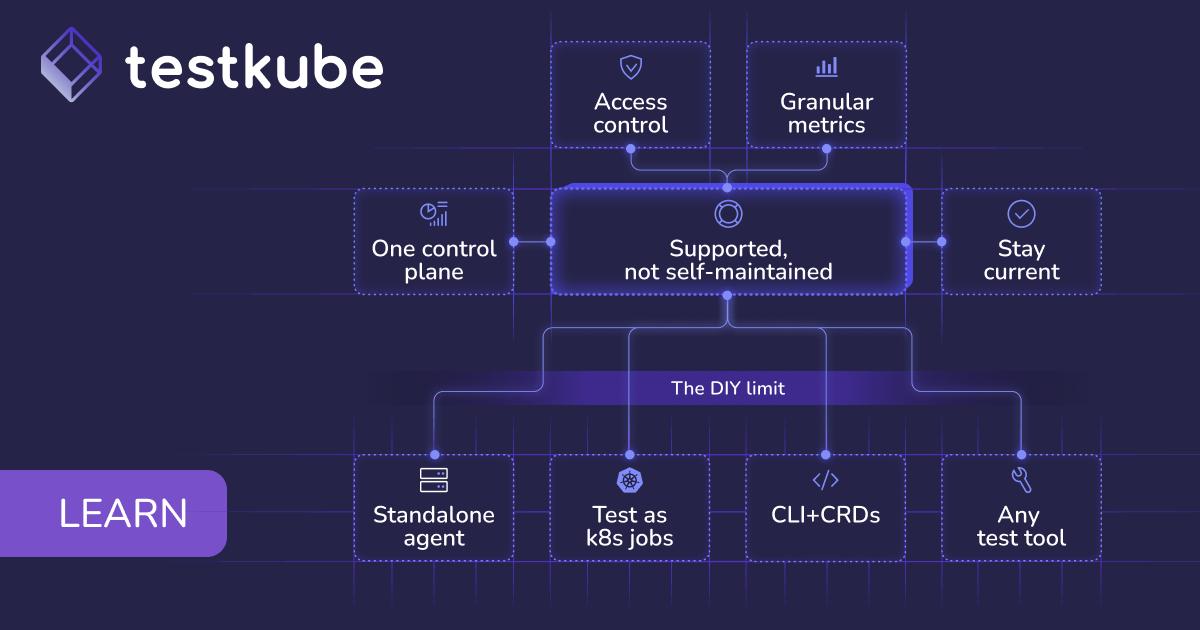
A standalone agent runs in one Kubernetes cluster and is managed through the CLI or the agent API. That is a clean architecture for one environment. It becomes an operational problem the moment there are two, because each cluster gets its own agent, its own configuration, and its own separate view of what happened.
Staging and production, Dev and QA, two regions. A regulated cluster and everything else. Whatever the split, the work of keeping those installations aligned falls on somebody, and there is no single place to answer the question "did that test pass everywhere."
A Control Plane is what changes here. Agents stay inside your infrastructure and continue to execute tests locally, but they report back to one interface. The feature comparison in the docs lays out exactly which capabilities require that connection.
The tell: you have started keeping a text file of which cluster runs which version of the agent.
Sign 2: There is no single view of quality, just spreadsheets, screenshots, and chat threads
Open source gives you test execution, but it lacks the reporting layer to answer a simple and vital question: what is the state of quality today?
For a single engineer running tests from a terminal, that is fine. The results are right there. The problem arrives when leadership asks: how many teams are running tests, how often, what the pass rate is, and what this caught before it reached a customer?
Those questions are not idle. It is usually the moment your testing program either gets funded or gets deprioritized. Answering them from execution logs and a spreadsheet is possible, and it is also a recurring tax on the person who has to assemble it every quarter.
This is the reason a centralized dashboard turns out to matter more than teams expect. It is not primarily an operator convenience. It is the artifact you show upward to justify the program.
The tell: you have manually built a report about testing more than once.
Sign 3: Tests are moving toward production without an audit trail
Almost every team runs open source in staging without anyone asking questions. The conversation changes when workflows start touching production or production-like environments.
At that point the standard requirements arrive: single sign-on, role-based access control, the ability to scope who can run what against which environment, and an audit trail showing who ran what and when. Not because anyone distrusts the team, but because a test that can reach production is a path into production, and that is what a security review is for.
If you can predict that review is coming in the next two quarters, it is worth knowing now that access control is the boundary between the open source agent and the commercial platform.
The tell: someone has asked, in writing, how access to test workflows is controlled.
Sign 4: You are pinned to an old version of the quality platform
The Testkube dashboard moved to the commercial offering in version 1.17. The runner agent, CLI, and APIs remain under the MIT license and continue to be developed.
For teams whose QA engineers worked primarily through that dashboard, the practical effect was a choice: upgrade and lose the interface people use daily, or stay put. Staying put is the comfortable option in the moment. It also means every subsequent release, including security patches, sits on the other side of a decision nobody wants to make.
Version drift is quiet until it is not. It tends to surface during an audit, a CVE response, or a Kubernetes upgrade that the pinned version was never tested against.
The tell: you know the version you are running, and you know it is old, and you have a reason.
Sign 5: Someone has quietly become the chief maintainer
Nobody is assigned this role but it happens anyway.
One engineer knows how the runner is configured. They handle the upgrades, fix what breaks when the cluster changes, and answer questions from the teams that adopted it. It is perhaps a few hours a month, which is easy to dismiss, until you multiply it across a year and notice it is a meaningful slice of a senior engineer who was hired to do something else.
The cost is also fragile. It concentrates in one person, and it becomes visible on the day that person is on vacation during an incident, or leaves.
This is worth calculating honestly rather than assuming. Take the hours, multiply by the loaded cost, and compare the result to what the commercial platform actually costs. Sometimes self-hosting still wins. Often it does not, and the team has never done the math.
The tell: you can name the person without thinking about it.
Sign 6: Adoption has stalled at the people who live in the CLI
With the standalone agent, everything runs through the CLI or the API. That is a feature for platform engineers. It is a ceiling for everyone else.
QA engineers, engineering managers, and product stakeholders do not adopt a tool that requires kubectl access and a terminal. So testing stays with the people who already had it, and the coverage you wanted across teams does not materialize. The tool is not the bottleneck. The interface is.
The tell: you have wanted to roll testing out to a non-platform team for months and it has not happened.
What actually changes
The most common misunderstanding we hear: self-hosted and open source are not the same choice. Teams that cannot let data leave their environment sometimes assume the open source agent is their only option. The Control Plane runs fully on-premises and supports air-gapped deployment, and agents always execute inside your own infrastructure regardless of which path you take.
When you have not outgrown it
Not every team should upgrade.
If you run one cluster, your team is comfortable in the CLI, nobody outside the team needs visibility into results, and tests do not touch production, the open source agent is the right tool. It is a genuinely capable execution engine, and it is a far better foundation than scripting test execution inside a CI/CD pipeline. You can connect a Control Plane later without rebuilding anything, because it is the same agent either way.
The upgrade is worth considering when the constraint stops being technical and starts being organizational.
How to make the case internally
If you have read this far and recognized your team, the hard part is usually not the decision. It is the budget conversation. Three things tend to make that conversation shorter.
Lead with the maintenance number, not the feature list. Engineering leadership responds to the cost of a senior engineer's time more readily than to a comparison table. Estimate the hours, be conservative, and present it as a reallocation rather than a new expense.
Bring the question you cannot currently answer. If a director has ever asked for testing metrics and you could not produce them quickly, that unanswered question is your business case. It demonstrates the gap better than any description of a dashboard.
Check whether another team is already using it. In larger organizations, open source adoption is frequently spread across several teams that do not know about each other. Consolidating into one agreement is a stronger ask than a single-team request, and it usually prices better.
One more practical note that surprises people: if your organization already runs the open source agent, Testkube may already be an approved vendor internally. That can remove weeks from procurement, and it is worth checking before you assume the process will be slow.
{{banner-get-started}}
Frequently Asked Questions
About Testkube
Testkube is the open testing platform for AI-driven engineering teams. It runs tests directly in your Kubernetes clusters, works with any CI/CD system, and supports every testing tool your team uses. By removing CI/CD bottlenecks, Testkube helps teams ship faster with confidence.
Get Started with a trial to see Testkube in action.