Table of Contents
Start your free trial.
Start your free trial.

Start your free trial.



Table of Contents
Executive Summary
On release night, the Cypress suite passes, the Postman collection passes, and the k6 load test passes, so everyone signs off and the release goes out. Three hours later, checkout is down in production.
The problem wasn't a missed bug or a test that failed to catch something. While validation was still running, a separate hotfix had been merged, and that newer build was the one that ultimately made it to production. The tests were accurate. Nothing was undertested. The gap was simpler: the pipeline never verified that the artifact being promoted was the same artifact that had passed validation.
The real issue isn't a shortage of testing capability. Most engineering organizations already run multiple testing tools and platforms across functional, API, performance, and security testing, and those tools work fine on their own. Validation answers one question (does the application behave as expected under a defined set of conditions?), while orchestration answers a different one: how should all of those validations be coordinated so the right one happens at the right point in the delivery process, instead of depending on manual handoffs or logic scattered across a pipeline?
That's the gap this piece covers: what a testing platform gets you, what orchestration adds on top of it, where that gap shows up in practice, and how Testkube closes it.
Testing tools vs. testing platforms vs. test orchestration: what's the difference?
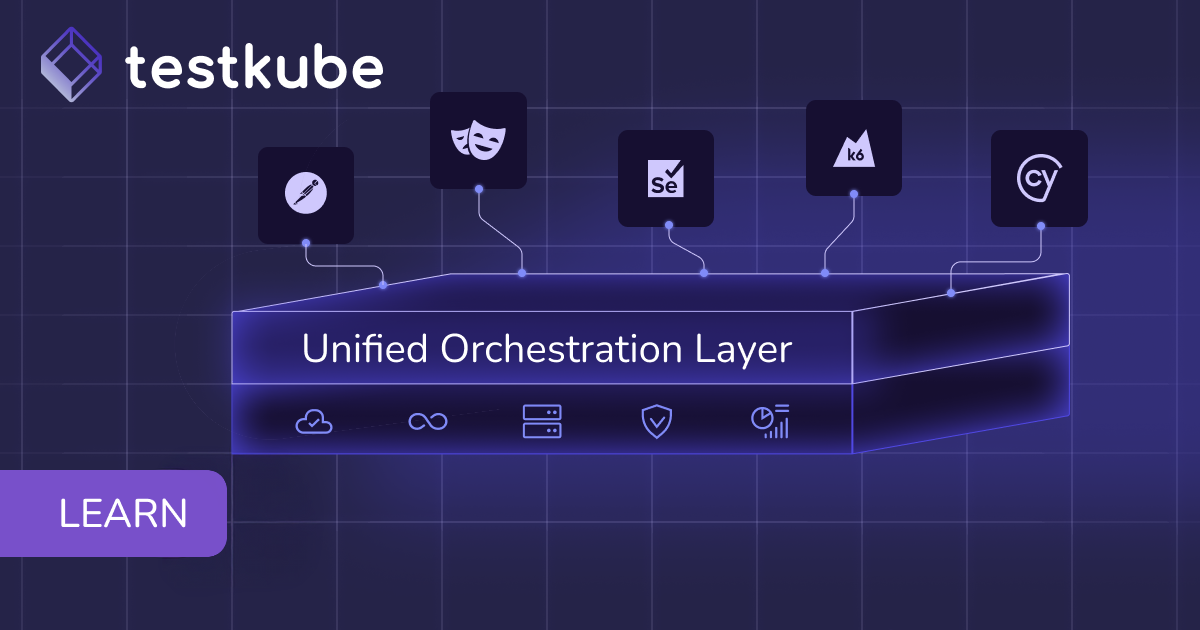
Testing tools like Cypress, Postman, and k6 are each built for one job. Cypress runs end-to-end browser tests, Postman runs API tests, k6 runs load tests, and each one is genuinely good at what it does. Testing platforms sit a layer above the tools, adding execution management, environment provisioning, integrations, access controls, reporting, and collaboration on top of one or more of those tools. Platforms like BrowserStack and Sauce Labs run cross-browser and real-device testing at scale, with built-in device farms and reporting already wired in, and BlazeMeter does the same for performance testing, layering test data generation, service virtualization, and analytics on top of a tool like JMeter. If you're weighing these platforms against each other directly, we compared Sauce Labs, BrowserStack, and Testkube and when each one actually fits your stack.
Test orchestration is a different layer again, and it's easy to conflate with a testing platform because both sit above individual tools. Orchestration coordinates testing activity across tools, platforms, and systems: what runs, when it runs, where it runs, and what happens next based on the result. It doesn't replace the tools or the platforms you already use. It decides how they work together, which is exactly the part that tends to get left out when teams keep adding platforms without ever building the layer that connects them.
A working analogy: testing through the SDLC
A testing tool validates one part of the software, like an API endpoint or a checkout flow, in isolation. A testing platform gives that validation the environment, configuration, metrics, and artifacts it needs to be trustworthy and repeatable, so the API test and the end-to-end test are both run consistently, tracked, and reported on properly.
But a release can pass every individual test and still fail when all those pieces have to come together. Unit tests can pass in CI, API tests can pass in staging, and end-to-end tests can pass as well, but the release can still break if those tests ran against different builds, in the wrong order, or before a required dependency was ready. Each test passed, but nothing checked whether the entire release was validated as one system.
Test orchestration is the layer that coordinates those validations based on changes, dependencies, and events, so the right tests run at the right time and against the right version. It connects individual testing activities into one process, so a collection of passing tests doesn't get mistaken for a fully validated release.
What a testing platform gets you
Centralized testing and management
A testing platform gives you one place to manage testing instead of scattering it across scripts, spreadsheets, and whoever remembers how the last run was configured. In practice, that usually means:
- Test execution, test suites, and configurations managed in a central system, so a run is set up the same way every time instead of depending on someone's local machine or memory.
- Test data, results, and history kept in one place, so results stay comparable across runs instead of living in scattered output folders.
- A consistent way to organize and execute testing across projects and teams, so every group isn't inventing its own process from scratch.
Infrastructure, integrations, and access
Platforms also connect testing into the systems already in use, including CI/CD, repositories, environments, and the rest of the engineering stack. That typically includes:
- Direct connections into CI/CD systems, repositories, and environments, so testing runs as part of the existing pipeline instead of as a separate side process.
- Access controls and permissions, so different teams can manage and consume testing capability appropriately without stepping on each other's configurations or results.
- Integration with the tools teams already use, so testing doesn't turn into an isolated activity that only one group understands.
What test orchestration actually adds
Coordinating what runs and when
Orchestration decides what runs and when, which is a different job than running any one test well. In practice, it can:
- Trigger the right testing activity automatically based on code changes, deployments, environments, schedules, or release stages, instead of relying on someone to remember to kick it off.
- Sequence testing stages and define the dependencies between them, so a later stage doesn't start before the results it depends on are actually in.
- Run independent testing activities in parallel while holding dependent ones back, and apply conditions so the next step changes depending on what the previous step returned.
Connecting environments and testing stages
Orchestration also coordinates testing across environments and keeps testing aligned to the right version of the application at every stage:
- Coordinates testing across development, staging, ephemeral, and production-like environments, so the same workflow logic applies no matter which environment it's running against.
- Connects deployment activity to the testing that needs to happen right after it, instead of leaving that connection to a person remembering to trigger it.
- Manages how context and artifacts move between testing stages, so results and outputs from one stage are available to the next without manual copying.
- Ensures testing always runs against the correct version of the application in the correct environment, rather than against an artifact that's already stale by the time the test starts.
Bringing testing results together
Once testing runs across multiple platforms and stages, someone still has to make sense of all the results together:
- Collects results and context from different testing platforms and stages into one place.
- Correlates those results with the specific commit, deployment, environment, and release being validated, so a result can always be traced back to what it was actually testing.
- Provides a complete view of the testing workflow, instead of requiring teams to reconcile several dashboards by hand.
- Uses the combined results to determine whether the required validation is actually complete and whether the release can move forward.
In Testkube, this extends past the testing workflow itself. Webhooks send test execution events and results out to external systems, so testing status and context can flow into tools like Slack or Grafana without needing a custom integration built for every workflow.
Where this gap shows up in engineering organizations
When green tests still break releases
Individual testing platforms can report success while the overall release still has gaps. A platform validates an application under a defined environment and configuration, and reports the metrics relevant to that scope. The problem starts once a release needs validation across multiple platforms, environments, or stages at the same time. A functional testing platform might validate application behavior correctly, and a performance testing platform might validate load characteristics correctly under its own configured conditions. Both can genuinely report success within their own scope, and both can be telling the truth at the same time.
The orchestration question is a different one entirely, and it's usually the one nobody was ever explicitly assigned to answer:
- Which platform should run first, and which results need to come back clean before the next stage even starts?
- Which environments should be created fresh for this run, and which should be reused?
- What happens if one stage fails partway through? Does everything stop, or does something else continue anyway?
- Who, or what, decides the release is actually cleared to move forward once every platform involved has reported in?
Without orchestration, every one of these testing platforms can be working exactly as intended, while the relationship between their results still depends on whatever CI/CD logic, custom integration, or manual coordination someone happened to build, sometimes years earlier, by someone who may not even be on the team anymore.
The tax of testing platform sprawl
As organizations adopt more testing platforms, the coordination burden grows right along with them:
- The number of integrations and handoffs between platforms grows with every new platform added.
- CI/CD pipelines fill up with conditional logic deciding which platform runs next and what happens once a result comes back.
- Teams end up writing their own scripts and internal automation just to pass information between systems and reconcile results by hand.
- Over time, that patchwork becomes an unofficial orchestration layer that nobody actually designed, and it's difficult to maintain, troubleshoot, or standardize across teams.
- Adding another testing platform at that point doesn't just add testing capability; it adds one more thing that the unofficial coordination logic has to account for.
Governance can't enforce what it can't see
Governance needs more than a pass or fail from each individual testing platform:
- Teams need to prove that the required testing stages actually happened before a release moved forward, not just that testing happened somewhere.
- That means having an auditable record of what was triggered, what environment it ran in, what dependencies were satisfied, and what results allowed the workflow to continue.
- When that information is scattered across multiple systems, proving the complete validation process was followed becomes genuinely difficult, even when every individual test did run exactly as expected.
Orchestration is what creates one consistent workflow and one consistent record of how testing was performed across the entire delivery process, which is what governance actually needs to point to when someone asks what happened.
How Testkube acts as the orchestration layer
Control Plane and Agents
Testkube splits the work into two parts:
Control Plane (H4)
The Control Plane is the central component for managing connected agents and coordinating testing across environments. It includes:
- API Service for REST, gRPC, and WebSocket communication
- Dashboard for managing tests, environments, and users
- Worker Service for asynchronous operations such as test executions and artifacts
Agents
Agents handle test execution within the environments where the workloads run. Each agent includes its own API service, NATS message broker, and Operator. The Operator reconciles Test, Test Suite, and Test Workflow Execution resources and triggers the corresponding test runs when those resources change.
This separation keeps test execution close to the workloads while giving teams a central place to coordinate testing across environments. It also means teams don't have to force every test or environment into a single cluster or platform.
We go deeper into how this model scales across clusters, including the newer GitOps agent, in our writeup on the control plane and GitOps agent.
Building test workflows
Test Workflows define what runs, in what order, under what conditions, and against which environment. They let you:
- Connect different testing activities into a single workflow instead of managing each one as its own isolated execution.
- Define dependencies, parallel execution, retries, and conditions all as part of the same workflow definition.
- Set up environment provisioning as a step within the workflow itself, rather than as something handled separately beforehand.
Workflows can be triggered from events such as code changes, deployments, schedules, or other delivery events. Testkube's Triggers provide that event-driven connection between Kubernetes events and test execution, so a configured trigger can start a Test Workflow automatically the moment a matching event occurs, such as a new service version being deployed. The same workflow can also be started manually from the Dashboard, from CI/CD, on a schedule, in response to an Execution CRD or Kubernetes event, from the CLI or REST API, or from another workflow finishing. If you want a step-by-step walkthrough of setting one of these up, we cover it in Getting Started with Test Workflows for Kubernetes Testing.
One dashboard
Testkube brings testing activity and results together in one place, so teams don't have to jump between individual platforms to piece together what happened. Specifically, it gives you:
- Visibility into the complete workflow, from the trigger that started it, through execution, to the final result.
- A clear view of which stages ran, which failed, and what actually caused the overall workflow to stop or continue.
- A shared view that developers, QA, platform teams, and release stakeholders can all work from, instead of everyone keeping their own version of the truth.
That matters most when something fails and someone has to figure out why fast. We've written about how AI agents can automate root cause analysis inside Testkube, correlating failed executions with the surrounding context so teams aren't reconstructing what happened by hand every time.
Conclusion: validation is not orchestration
Testing platforms give teams the capability to execute and manage testing well. Test orchestration is what coordinates that capability across platforms, environments, and delivery stages, and the two were never competing for the same job.
A green result from every individual testing platform doesn't automatically mean the release validation process was actually complete. That's the gap that shows up on release night, not because any test was wrong, but because nothing was coordinating what those tests meant together. The goal was never to replace the testing platforms teams already rely on. It's to make them work together as one coordinated system instead of a set of disconnected green checkmarks.
Validation tells you what passed. Orchestration tells you whether the right validation happened at all.
If Build B is still going to slip past every green checkmark on your next release, it's worth looking at where the coordination gap actually is. See how Testkube brings your testing platforms together into one orchestrated workflow.
{{banner-get-started}}
About Testkube
Testkube is the open testing platform for AI-driven engineering teams. It runs tests directly in your Kubernetes clusters, works with any CI/CD system, and supports every testing tool your team uses. By removing CI/CD bottlenecks, Testkube helps teams ship faster with confidence.
Get Started with a trial to see Testkube in action.