Table of Contents
Start your free trial.
Start your free trial.

Start your free trial.



Table of Contents
Executive Summary
The idea behind shift-left testing is simple: find problems earlier rather than later. Run tests during development, not after deployment. Catch bugs before they reach production. The concept has been around since 2001, when Larry Smith first used the term, and it is now standard advice in any DevOps or CI/CD guide.
The problem is that most shift-left advice was written for monolithic applications deployed to static servers. For teams running microservices on Kubernetes, following that advice literally can create a false sense of security. You are testing earlier, yes. But you are testing in an environment that does not match where the code actually runs. That is not shifting left. That is just failing faster in the wrong place.
This post is about what shift-left actually means when your production environment is a Kubernetes cluster, and why the standard playbook needs adjusting.
The standard shift-left playbook
In the traditional model, shift-left testing means a few things: write unit tests alongside your code (or before it, if you practice TDD), run those tests automatically in CI on every commit, add integration tests that run against your service's API, and catch as many issues as possible before the code moves downstream.
This is good practice. Nobody is arguing against unit tests or CI automation. The question is whether this is sufficient for cloud-native applications, and the answer is that it is not.
The standard playbook assumes that if your code passes its tests, it is ready to deploy. That assumption held when "deploy" meant copying a binary to a server. It falls apart when "deploy" means packaging code into a container image, writing Kubernetes manifests that describe resource limits, network policies, RBAC rules, service accounts, and health probes, then letting a scheduler place your pods across a multi-node cluster governed by admission controllers and a service mesh.
The gap between "my tests passed in CI" and "my application works in Kubernetes" is not a gap you can close with more unit tests.
What the gap looks like in practice
A developer writes a service, writes tests, pushes code. CI builds the container image, runs the test suite, everything passes. The deployment pipeline applies the Kubernetes manifests to the cluster. Then one of these things happens:
- OOMKilled pods. The pod starts but gets killed because the CI container had no memory limit and the Kubernetes pod spec sets a limit of 256Mi.
- Network policy blocks. The service cannot reach a dependency because a network policy blocks egress that was not present in the test environment.
- Mocked dependency mismatch. An integration test passed against a mocked authentication service, but the real auth-api in the cluster returns a different token format after a recent update.
- Readiness probe failures. The pod fails its readiness probe because it takes 45 seconds to initialize and the probe timeout is 30 seconds. The probe does not exist in the test environment, so this never surfaces.
These are not exotic failures. They are the normal result of testing in one environment and deploying to a fundamentally different one. The shift-left playbook told the team to test early and often, and they did. But the tests ran in an environment that had no relationship to production.
Shift-left for Kubernetes means testing in the real environment earlier
For cloud-native teams, shifting left is not just about timing. It is about environment fidelity.
Running unit tests in CI on every commit is still valuable. That is table stakes, not the finish line. The shift-left question for Kubernetes teams is: how early in the development cycle can you test against actual cluster conditions?
That means testing with real resource limits, not unlimited CI containers. It means testing with the network policies that will be enforced in production. It means running integration tests against real services in a namespace, not mocked endpoints in a Docker container. It means validating that your manifests produce healthy pods, not just that they parse correctly.
The earlier you can do this, the more problems you catch before they become incidents. But there is a practical constraint: spinning up a full Kubernetes environment for every pull request is expensive and slow if you do it the traditional way (provision a cluster, deploy everything, run tests, tear it down).
This is where the implementation gets interesting, and where most teams either give up or settle for something that looks like shift-left without delivering the benefits. The deeper case for running tests in your actual Kubernetes environment walks through why this matters for AI-generated code specifically, but the principle applies to all cloud-native development.
The three levels of shift-left in Kubernetes
Not every team needs the same level of environment fidelity. The approaches stack like this:
Level 1: Static validation
The lightest version of shift-left and the easiest to implement. Run manifest validation tools like kubeconform or kubeval in CI to catch structural errors. Run policy checks with OPA/Gatekeeper or Kyverno to enforce organizational standards (every deployment must have resource limits, every pod must have a non-root security context). Scan container images with Trivy or Grype for known vulnerabilities.
This catches a real category of problems: malformed YAML, missing required fields, policy violations, vulnerable base images. It is fast, cheap, and runs on every commit. It only validates the static configuration, though. It tells you nothing about whether the application actually works in a cluster.
Level 2: Lightweight cluster testing
Run a Kubernetes-in-Docker (KinD) or k3s cluster inside CI and deploy your application there. This lets you test against actual Kubernetes primitives: resource limits are enforced, network policies work (if you install a CNI that supports them), RBAC rules apply.
The tradeoff is time and fidelity. Standing up a KinD cluster, deploying your manifests, waiting for pods to become healthy, running tests, and tearing it down can add 5-15 minutes to your pipeline. The cluster also is not identical to production: it is single-node, it does not have the same cloud provider integrations, and it probably does not have your full service mesh installed.
Still, KinD catches problems that pure static validation misses. A deployment that sets memory limits too low will OOMKill here, not just in production.
Level 3: In-cluster testing
Run your tests inside the actual Kubernetes cluster where the code will be deployed (or a cluster that mirrors it closely). Tests execute as native Kubernetes jobs, subject to the same network policies, resource limits, RBAC, and service mesh rules as production workloads.
This is the highest fidelity and the closest to true shift-left for cloud-native: your tests run in the real environment from the beginning, not just at the end. The tradeoff is that it requires tooling to make it practical. You need a way to trigger test workflows inside the cluster from your CI pipeline, collect results back, and manage the lifecycle of test pods.
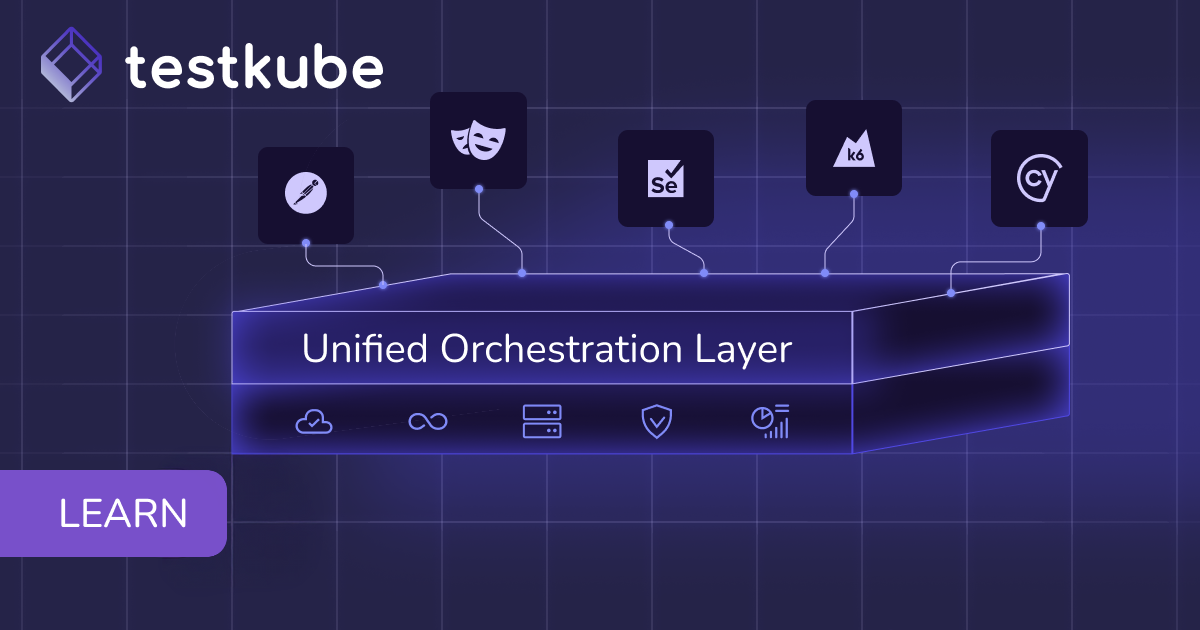
Testkube is built for this level. It runs test workflows as native Kubernetes jobs inside your cluster, triggered by CI events, schedules, Kubernetes events, or API calls. Your CI pipeline stays simple (build, push image, trigger Testkube) while the actual testing happens in-cluster with full environment parity. You can run any framework (k6, Cypress, Postman, JMeter, Selenium, and others) without having to containerize them yourself or write custom pipeline scripts.
Why most teams get stuck at Level 1
If in-cluster testing is the gold standard, why does not everyone do it?
The honest answer: Level 1 is easy. You add a linting step to your CI pipeline and you are done. It runs in seconds, does not require any additional infrastructure, and catches enough problems to feel productive.
Level 2 requires maintaining KinD or k3s configurations in CI, which adds complexity and build time. Teams try it, find that it slows their pipeline from 3 minutes to 15, and either optimize it (parallel jobs, cached images) or abandon it.
Level 3 requires the most investment upfront. You need a test orchestration layer inside your cluster, a way to manage test workflows, and a strategy for isolating test runs from production traffic. Without the right tooling, building this yourself is a significant engineering project.
The result is that most teams stop at Level 1, tell themselves they have shifted left, and continue finding out about Kubernetes-specific failures in staging or production. They have shifted the timing of their tests without shifting the environment their tests run in.
Shift-right is not the answer either
Some teams respond to this problem by going the other direction: shift-right testing, or testing in production. Run canary deployments, monitor error rates, roll back if something breaks. The production environment is, by definition, perfectly representative of production.
Shift-right has its place. Canary deployments, progressive delivery, and production observability are valuable practices. They are not a substitute for shift-left. Testing in production means your users are part of the test. Even a 1% canary that catches a bad deploy means 1% of your users experienced the failure.
The better approach is both: shift-left with environment-appropriate testing so fewer problems reach production, and shift-right with observability so you catch the ones that slip through. These are not competing strategies. They are complementary layers.
What this looks like day-to-day
For a team that is doing shift-left testing well on Kubernetes, a typical development cycle looks like this:
- A developer writes code and pushes to a feature branch.
- CI runs unit tests and static validation (Level 1) in seconds.
- If those pass, CI builds the container image and triggers a test workflow inside the cluster (Level 3).
- The test workflow deploys the service to an ephemeral namespace, runs integration tests against real dependencies with real network policies enforced, and reports results back to the CI pipeline.
- If tests pass, the image is promoted to staging.
- Post-deploy smoke tests run automatically in staging, triggered by a Kubernetes event, and report results to Testkube's centralized dashboard.
- The developer sees a single view of all test results, from unit tests through production smoke tests, without checking three different CI tools.
The total cycle time might be 8-10 minutes, with most of that spent on the in-cluster tests. Compare that to finding the same problems in production three hours later and spending 45 minutes on an incident.
The shift-left checklist for cloud-native teams
If you want to evaluate where your team stands, ask these questions:
- Are you validating Kubernetes manifests in CI before they are applied? (Static validation, policy checks, image scanning.)
- Are your tests running against actual Kubernetes primitives, or against mocked environments? (Resource limits, network policies, RBAC, service mesh.)
- How long does it take from code push to knowing whether the code works in a cluster? If the answer is "we find out in staging" or "we find out in production," you have not shifted left enough.
- When a test fails, can you tell whether it failed because of a code bug or an environment mismatch? If you cannot, your test environment is not representative.
- Do you have a centralized view of test results across all stages and clusters, or are results scattered across CI tools? Scattered results make it hard to improve.
If most of your testing happens in CI containers with no cluster context, you have shifted the timing of your tests but not the environment. That is the gap that causes cloud-native teams to ship bugs their test suite should have caught.
Key takeaways
- Shift-left is about environment, not just timing. Testing earlier in a CI container that does not match production gives a false sense of security. True shift-left for cloud-native teams happens in environments that match production.
- Three levels of shift-left exist in Kubernetes. Level 1: static validation (kubeconform, Kyverno, Trivy). Level 2: lightweight cluster testing (KinD, k3s). Level 3: in-cluster testing as native Kubernetes jobs.
- Most teams stop at Level 1. It is easy, fast, and catches enough problems to feel productive. It misses every Kubernetes-specific failure that happens when the application actually runs in a cluster.
- Shift-right does not replace shift-left. Canary deployments and production observability catch what slips through, but they make your users part of the test. The two approaches are complementary, not competing.
- In-cluster testing requires a test orchestration layer. Without one, Level 3 is a significant engineering project. Testkube provides that layer so test workflows run as native Kubernetes jobs inside your cluster from any CI event, schedule, or API call.
Frequently asked questions
What is shift-left testing?
Shift-left testing is the practice of finding problems earlier in the development cycle by running tests during development rather than after deployment. The term was coined by Larry Smith in 2001. Standard shift-left includes unit tests written alongside code, CI automation on every commit, and integration tests against service APIs. For cloud-native teams, true shift-left also requires testing in environments that match production, not just testing earlier.
Why does standard shift-left advice fail for Kubernetes teams?
Standard shift-left advice was written for monolithic applications deployed to static servers. When deploy means scheduling containers across a multi-node Kubernetes cluster with resource limits, network policies, RBAC, service meshes, and admission controllers, testing in CI containers without that context creates a false sense of security. The tests pass, the deployment fails, and the team is left finding Kubernetes-specific failures in staging or production.
What are the three levels of shift-left testing in Kubernetes?
Level 1: static validation using tools like kubeconform, OPA/Gatekeeper, Kyverno, and Trivy to catch structural errors and policy violations. Level 2: lightweight cluster testing with KinD or k3s in CI to test against actual Kubernetes primitives. Level 3: in-cluster testing where tests execute as native Kubernetes jobs inside the actual cluster, with full environment parity. Most teams stop at Level 1; the highest fidelity comes at Level 3.
What is in-cluster testing?
In-cluster testing means running tests as native Kubernetes jobs inside the actual cluster where the application will be deployed. Tests are subject to the same network policies, resource limits, RBAC rules, and service mesh configurations as production workloads. This is the highest-fidelity form of shift-left testing for cloud-native teams because the test environment matches production from the start, not just at the end of the pipeline.
Why do most teams get stuck at Level 1 shift-left testing?
Level 1 is easy: add a linting step to CI and you are done. It runs in seconds, requires no additional infrastructure, and catches enough problems to feel productive. Level 2 adds complexity and build time. Level 3 requires a test orchestration layer inside the cluster. Without the right tooling, the higher levels are significant engineering projects. Most teams stop at Level 1, tell themselves they have shifted left, and continue finding Kubernetes-specific failures downstream.
Is shift-right testing better than shift-left?
Neither replaces the other. Shift-right testing includes canary deployments, progressive delivery, and production observability. It is valuable but means real users are part of the test; a 1% canary that catches a bad deploy still affects 1% of users. The better approach is both: shift-left with environment-appropriate testing so fewer problems reach production, and shift-right with observability to catch the ones that slip through.
How do I implement Level 3 shift-left testing without building it myself?
Use a test orchestration platform like Testkube that runs test workflows as native Kubernetes jobs inside your cluster. Your CI pipeline stays simple (build, push image, trigger Testkube) while the actual testing happens in-cluster with full environment parity. You can run any framework (k6, Cypress, Postman, JMeter, Selenium) without containerizing them yourself or writing custom pipeline scripts.
About Testkube
Testkube is the open testing platform for AI-driven engineering teams. It runs tests directly in your Kubernetes clusters, works with any CI/CD system, and supports every testing tool your team uses. By removing CI/CD bottlenecks, Testkube helps teams ship faster with confidence.
Get Started with a trial to see Testkube in action.