Table of Contents
Start your free trial.
Start your free trial.

Start your free trial.



Table of Contents
Executive Summary
You have test results. You just cannot find them.
Ask most engineering teams where to find last week's test results and you will get a different answer from every person. The QA lead checks the GitHub Actions tab. The DevOps engineer pulls up Jenkins. The SRE looks at a Grafana dashboard that someone set up six months ago and stopped maintaining. The developer checks a Slack message from a bot that may or may not have fired. This is the kind of scattered visibility that pipeline sprawl creates, and it gets worse as your engineering org grows.
The tests are running. The results exist somewhere. Getting a clear picture of what passed, what failed, and what has been flaky for the past three weeks requires manual effort that nobody has time for.
This is not a tooling problem. It is an architecture problem.
Why test results end up scattered
Test results live where tests run. When tests run inside CI pipelines, results live in pipeline logs. When every team has its own pipeline configuration, results fragment across every one of those pipelines. When you add a second CI tool, or a third, the fragmentation multiplies.
Most engineering organizations did not design this. It accumulated. A team started with Jenkins. Another used GitHub Actions because it was faster to set up. A load testing suite runs on a schedule via a cron job. E2E tests run in a separate pipeline triggered by a different event. Each of those systems produces results. None of them talk to each other.
The result is that test reporting becomes a manual aggregation exercise. Someone has to know which system ran which tests, navigate to each one, and piece together a picture of release quality from separate data sources. That picture is always incomplete and always out of date by the time it matters. Teams in this position often end up running tests outside their CI pipeline entirely, not because CI failed them, but because CI was never built to be the source of truth for testing.
Why a dashboard will not fix this
The instinct is to solve scattered results with a dashboard. Build something that pulls from Jenkins, GitHub Actions, and the load testing tool, normalize the results, and display them in one place.
That works until it does not. The integration breaks when a CI tool updates its API. The normalization logic does not account for a new test type. Someone adds a fourth pipeline and the dashboard does not know about it. Now you are maintaining a bespoke aggregation layer on top of all the systems you were already maintaining.
The real requirement is not a dashboard. It is a single execution layer that all tests run through, so results are centralized by default rather than aggregated after the fact.
The difference matters. Aggregation is fragile because it depends on every upstream source staying consistent. A unified execution layer produces results in one place from the start, regardless of which tool ran the test or which environment it ran in.
What gets easier when reporting is centralized
Four things become significantly easier the moment all test results land in one place.
Release readiness
When results from every test type (functional, load, integration, E2E) are visible in one place, release readiness becomes a fact rather than a feeling. The question "are we good to ship?" has a data-backed answer instead of requiring a meeting.
Failure triage
When a test fails, the time to identify it, route it to the right team, and understand the context depends entirely on how quickly someone can find the relevant logs and history. Scattered results mean scattered context. Centralized results mean one place to look, with execution history, artifacts, and trends in the same view.
Cross-team visibility
Platform teams and engineering managers need a view across teams, not just within them. When every team reports through a different system, that view does not exist. Centralized reporting makes it possible to see test health across the entire engineering organization without asking each team to compile a status update.
Trend detection
A test that fails occasionally is easy to miss in per-run results but obvious in a trend view. Flaky tests, degrading coverage, and environments that produce more failures than others all show up in aggregate data. None of that is visible when results are scattered.
How Testkube centralizes test reporting
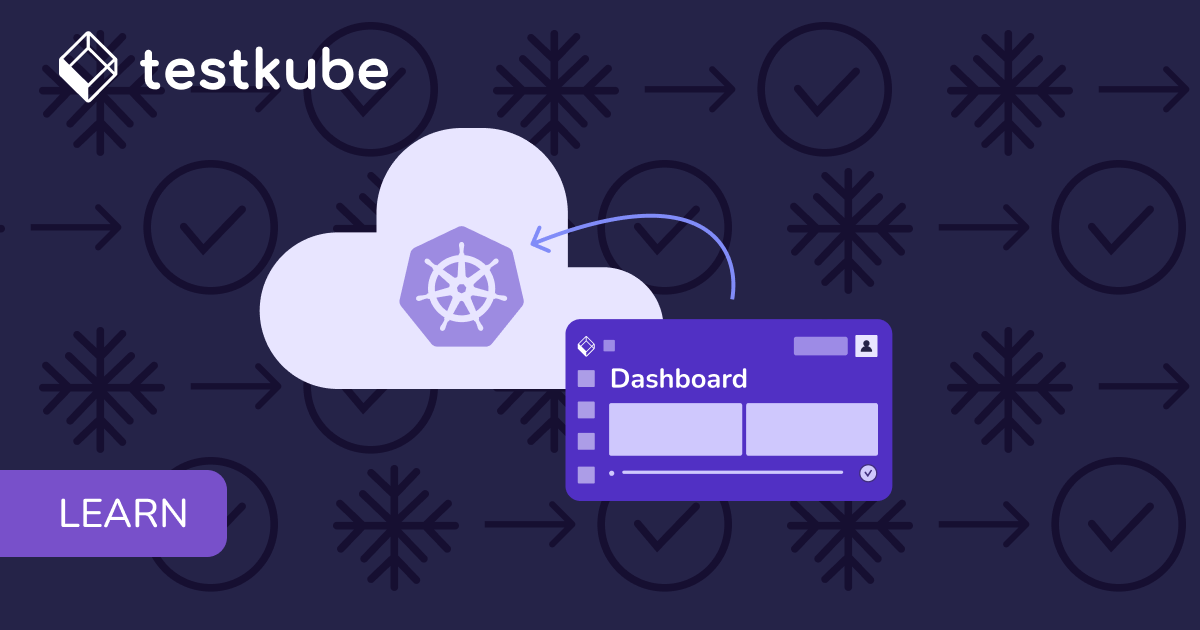
Testkube is a test orchestration platform that runs inside your own containerized infrastructure. Every test, regardless of type or tool, runs through Testkube as a workflow. Because execution is centralized, reporting is centralized by default.
Every run produces a structured result in the Testkube dashboard: pass/fail status, execution duration, logs, artifacts, and a full history of previous runs for that workflow. That data is consistent across every test type and every environment because it all comes from the same execution layer.
Teams keep their existing tools. Playwright, k6, JMeter, Postman, Cypress: none of that changes. What changes is that all of those tools run through Testkube, so their results land in the same place.
What this looks like in practice
A healthcare platform team managing nearly 150 microservices had no unified view of test results across their QA, Dev, and SRE teams. Each team used different tools and triggered tests through different systems. There was no single source of truth for test history, no way to see trends across teams, and no way to run a test without the right person available to interpret the output.
After adopting Testkube, all three teams ran their test suites through a single orchestration layer. Results landed in one dashboard regardless of which team triggered the run or which tool they used. During a production incident on a weekend, an SRE was able to pull up a saved test workflow, execute it, and read the result without navigating multiple systems or waiting for a QA engineer. The visibility that previously required manual aggregation was available immediately.
The same platform team eliminated weekly deployment meetings that had existed solely to manually verify release readiness. With centralized test results visible to everyone, those meetings became unnecessary.
The reporting gap is a symptom
Scattered test results are not a reporting problem. They are a symptom of running tests in too many places with no shared execution layer underneath.
The teams that solve this sustainably do not add another aggregation layer. They move test execution to a single orchestration platform, and centralized reporting follows naturally.
Key takeaways
- Scattered test results are an architecture problem, not a tooling problem. Results live where tests run. Multiple execution systems mean fragmented results, no matter how good your CI tool is at logging.
- Aggregation dashboards do not solve this sustainably. Every dashboard pulling from multiple sources eventually breaks when an upstream system changes. You end up maintaining a bespoke integration layer on top of every other tool.
- The real fix is centralized execution. When all tests run through a single orchestration layer, reporting is unified by default because results come from one place, not aggregated from many.
- Four things get easier: release readiness becomes a data-backed answer, failure triage gets faster, cross-team visibility becomes possible, and trends like flakiness and coverage decline become visible.
- You do not have to replace your testing tools. Teams keep their frameworks (Playwright, k6, JMeter, Postman, Cypress). The orchestration layer sits above them and centralizes execution.
Frequently asked questions
Why are my test results scattered across multiple tools?
Test results live where tests run. When tests run inside CI pipelines, results live in pipeline logs. When every team uses a different pipeline (or a different CI tool entirely), results fragment across all of those systems. Most organizations did not design this. It accumulated as teams adopted different tools over time. The root cause is fragmented execution, not bad reporting.
What is centralized test reporting?
Centralized test reporting is a single source of truth for test results across every team, tool, and environment. Instead of aggregating data from multiple systems after the fact, centralized reporting comes from a unified execution layer where all tests run. Results are consistent because they originate from the same place. Dashboards aggregate; centralized reporting eliminates the aggregation problem entirely.
Why do test reporting dashboards fail over time?
Dashboards that aggregate test results from multiple sources break when any upstream system changes. APIs update, new test types appear, additional pipelines get added, normalization logic falls behind. You end up maintaining a bespoke aggregation layer on top of all the systems you were already maintaining. The fix is centralizing execution, not adding another reporting layer.
What gets easier when test reporting is centralized?
Four things become significantly easier: release readiness becomes a fact rather than a feeling (data-backed answer instead of a meeting), failure triage gets faster because all logs and history are in one place, cross-team visibility becomes possible without manual status compilation, and trend detection (flaky tests, degrading coverage, environment-specific failures) becomes visible in aggregate data instead of getting missed in per-run results.
How is centralized execution different from a test reporting dashboard?
A test reporting dashboard aggregates results from multiple execution systems after they run. Centralized execution means all tests run through a single platform from the start, so results are unified by default. Aggregation is fragile because it depends on upstream consistency. Unified execution produces consistent results regardless of which tool ran the test or which environment it ran in.
Do I need to replace my testing tools to centralize reporting?
No. Teams keep their existing tools (Playwright, k6, JMeter, Postman, Cypress) and run them through a test orchestration platform like Testkube. Tests still execute using the same frameworks. What changes is that all of those tools run through one execution layer, so their results land in the same dashboard with consistent format, logs, artifacts, and history.
About Testkube
Testkube is the open testing platform for AI-driven engineering teams. It runs tests directly in your Kubernetes clusters, works with any CI/CD system, and supports every testing tool your team uses. By removing CI/CD bottlenecks, Testkube helps teams ship faster with confidence.
Get Started with a trial to see Testkube in action.