Table of Contents
Start your free trial.

Table of Contents
Executive Summary
If you're comparing test orchestration platforms, something probably broke first: the nightly regression that finishes after the team is already online, the failure nobody can reproduce off a laptop, or the audit request nobody can answer because last month's CI logs expired.
By then your team probably runs several frameworks through several pipelines. The question to answer is how to run all of them at scale inside the Kubernetes clusters where your software runs. That's the job of Kubernetes test orchestration.
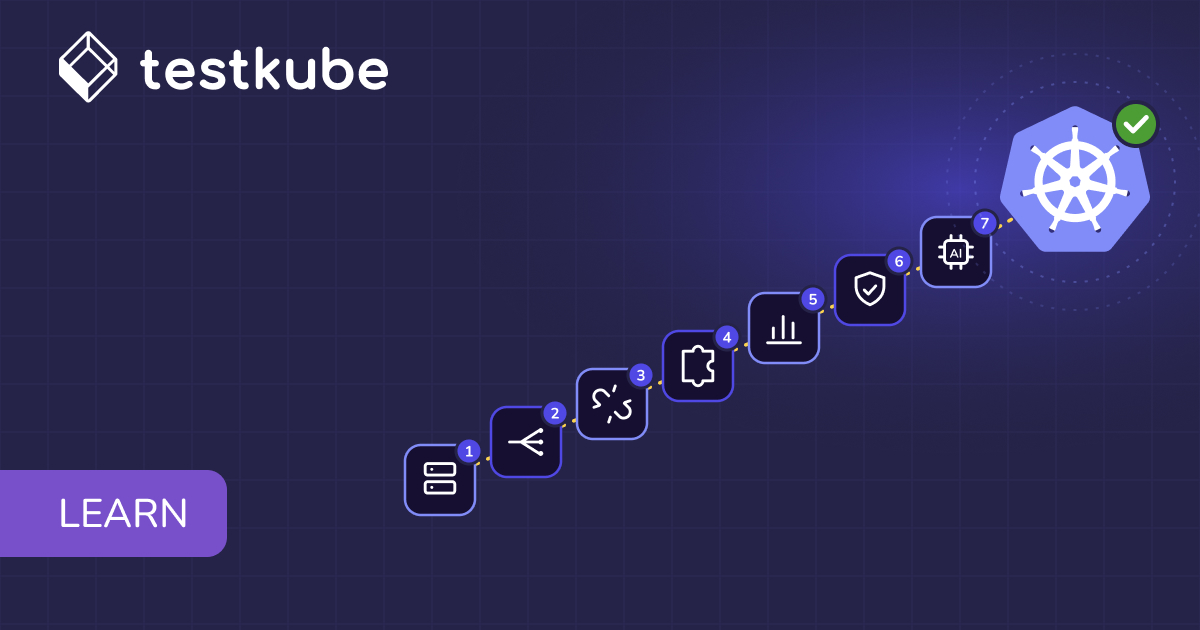
The seven questions below separate a platform that fits your QA strategy from one that becomes another silo. Use them as a checklist when you compare QA management tools and test automation platforms for cloud-native teams.
What is Kubernetes test orchestration?
Kubernetes test orchestration is the practice of scheduling, running, scaling and reporting on automated tests from inside Kubernetes clusters, independent of any single CI/CD tool. Instead of each pipeline owning its own scripts and runners, an orchestration platform treats tests as workloads. It starts them as pods, spreads them across nodes and collects every result in one place.
If your team already chains test jobs together in pipelines, you're already doing test orchestration, just by hand. A Kubernetes-native testing platform replaces those hand-built chains with test definitions that any pipeline or schedule can run.
1. Do tests run inside our Kubernetes clusters?
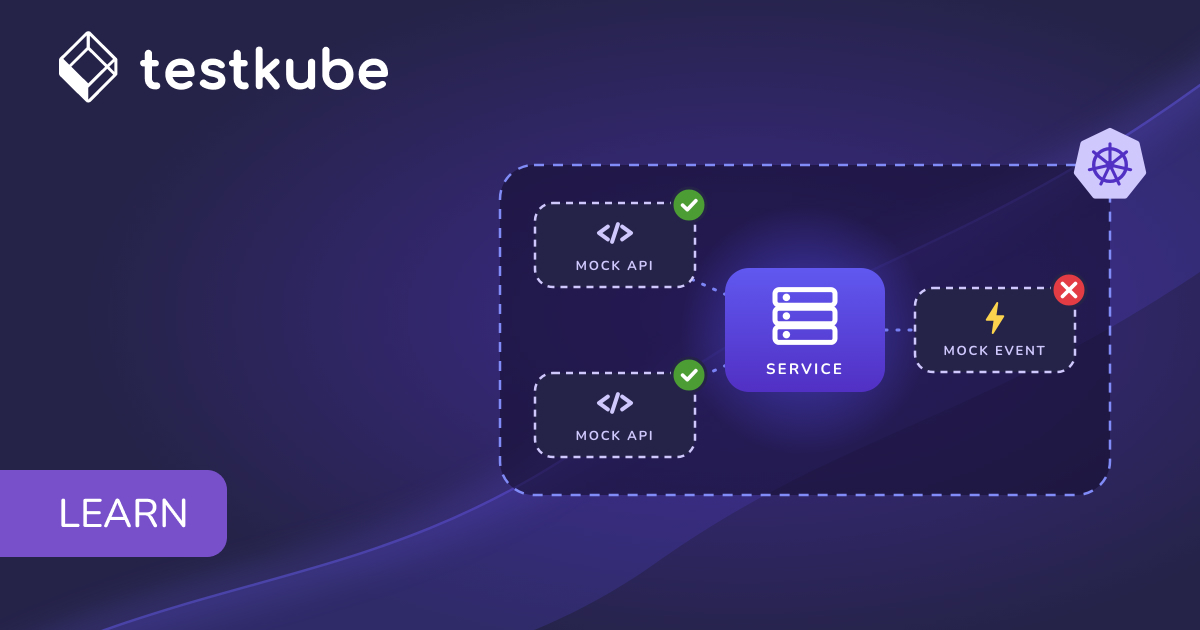
Start here, because the answer decides how much you can trust your results. Tests that run on a CI runner or a laptop reach your services through ingress, port forwards or test-only endpoints. Production traffic doesn't take that path, so you get failures that only happen in one place and passes that don't hold up after release.
A Kubernetes-native platform runs tests as pods in the same cluster as the application, often in the same namespace. Tests hit the same service discovery, network policies and resource limits your users depend on. We cover the trade-offs in more depth in the hidden cost of testing outside the cluster.
Questions to ask each vendor:
- Execution location: Do tests run in our cluster, in the vendor's cloud or on a shared runner?
- Environment coverage: Can we put a runner in each cluster and environment, from dev to production-like staging?
- Install footprint: What does the platform need from Kubernetes, and which permissions does it request?
- Partial Kubernetes adoption: If some services still run on VMs, can a small cluster act as the test runner while the app lives elsewhere?
In Testkube, Runners are lightweight components you install with Helm or the CLI. They execute tests inside the clusters and namespaces where you deploy them, while the control plane handles the dashboard and coordination.
2. Can it scale test execution without a single bottleneck?
Picture one shared runner working through a regression suite in sequence, across several regions and browser configurations. The suite grows, the run stretches past the nightly window, and results arrive late or time out. More CI runners help for a while, until queueing and cost catch up.
In Kubernetes, scale comes from the cluster itself. Ask:
- Fan-out: Can one test step run across many pods and nodes at the same time?
- Sharding: Does it split suites for frameworks like Playwright and Cypress without custom scripting?
- Distributed load: Can it run k6 or JMeter from multiple workers in one execution?
- Pricing model: Does cost scale per cluster, per runner, per user or per run? If you buy capacity up front, ask how licensing flexes when demand changes.
Testkube's parallel steps run a single workflow step across multiple pods and nodes. See scaling Playwright tests with Testkube for a worked example of sharding a browser suite.
3. Is test execution decoupled from CI/CD?
If your tests live inside pipeline definitions, each Jenkins job or GitHub Actions workflow has its own way to install dependencies, run tests and store output. That coupling causes problems for a QA manager. Tests only run when a pipeline runs, so you can't rerun a suite against staging without kicking off a build. Pipeline logs are thin, so failures get rerun on laptops to find out what happened. And switching CI tools means rewriting tests, because your test strategy is locked to your build tool.
A decoupled testing platform defines each test once and lets anything trigger it:
- CI/CD pipelines: Jenkins, GitHub Actions, GitLab CI, Azure DevOps, CircleCI and Tekton
- GitOps tools: Argo CD and Flux, including as deployment gates
- Schedules: cron-based runs for nightly regression or synthetic checks
- Kubernetes events: a deployment finishing or a resource changing
- Direct runs: the CLI, the API or the dashboard
The test is simple: does the same test definition behave the same way no matter what triggers it? If the answer depends on the CI tool, nothing has been decoupled. We make the full case in stop running tests with your CI/CD tool.
4. Will it run the frameworks we already use?
Your stack might include older Selenium suites, a Playwright migration in progress, Postman collections owned by the API team, k6 scripts for load and a custom Python harness or two. A platform that asks you to rewrite all of that pushes value out by months.
- Tool coverage: Does it run any containerized test tool, or only a fixed list?
- Bring your own tests: Can it pull existing tests straight from our Git repositories, unchanged?
- Mixed workflows: Can one workflow chain API, UI and performance checks into a single quality gate?
- Known limits: What won't it do? An orchestration platform can run your mobile suites, for example, but it doesn't replace a real-device cloud. Ask about those limits before the proof of concept starts.
Testkube runs any tool that runs in a container, so teams keep their frameworks and add orchestration on top instead of migrating first.
5. Do we get one view of results across teams and runs?
When every team runs tests through its own pipeline, results land in CI logs, framework reports, a test management tool and somebody's spreadsheet. Nobody can answer basic questions like which suites are getting slower or how often a given test fails.
Look for:
- One dashboard: pass/fail trends, durations and flaky-test patterns across every workflow
- Kept artifacts: logs, screenshots, videos and reports that survive after the test pod is gone
- Audit-ready history: execution records that don't disappear when a CI tool rotates its logs
- Filtering: labels to slice results by team, service, environment or pull request
- Integrations: exports to your test management, alerting and chat tools
You'll use the reporting every day after rollout, so ask for a live walkthrough instead of slides. For more on what good looks like, read how to centralize test reporting across teams or our definition of centralized test observability.
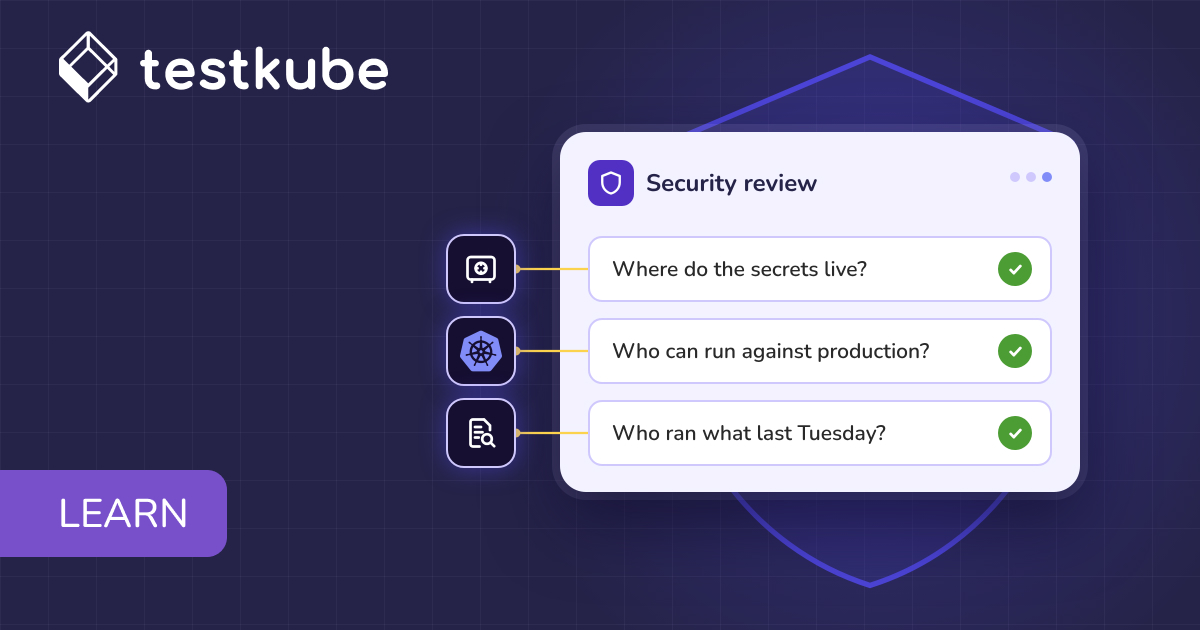
6. Does it meet our security and deployment requirements?
Bring platform engineering and security in at the start. Deployment and access questions can hold up a purchase long after the test capabilities check out.
| Requirement | What to ask |
|---|---|
| Deployment model | SaaS, self-hosted control plane or fully air-gapped? |
| Identity and access | SSO with our identity provider? Role-based access by team? |
| Audit trail | Is there a log of who ran, changed or approved what? |
| Data residency | Do test data, logs and artifacts stay in our infrastructure? |
| Cluster permissions | Which service accounts and RBAC rules does the runner need? |
| AI controls | Can AI be turned off, limited or pointed at our own model? |
Testkube supports cloud and self-hosted control planes, air-gapped installation, SSO, role-based access and audit logs. Each has a docs page your security team can review.
7. How does it handle AI-generated code and tests?
If your developers use AI coding assistants, you may already see more pull requests than your test runs can keep up with. Every extra change needs validation, and QA becomes the bottleneck.
- Throughput: Can the platform absorb the extra test runs AI-assisted development creates, without queuing?
- Failure triage: Does it use logs, artifacts and execution history to point at a likely root cause?
- Test creation: Can AI draft or update tests while people stay in control of what gets merged?
- Developer tools: Does it connect to the coding agents and IDEs your developers already use, for example through an MCP server?
- Governance: Can you choose models, bring your own, limit usage and see what agents did?
A practical split: agents take repetitive work such as first-pass failure analysis, and people keep the approvals. Your platform should support that split by default.
Testkube is the testing platform for the agentic SDLC. Its Troubleshoot agent reviews logs, artifacts and history when a workflow fails, agent triggers can start that analysis automatically, and the Testkube MCP Server works with Claude Code, GitHub Copilot and Cursor. You can use the built-in models or bring your own.
How to run the evaluation
A short evaluation process:
- Pick two or three problems you have today (the slow regression, the flaky suite, the audit gap) and write success criteria for each.
- Bring your own tests. Run an existing suite, unchanged, in your own cluster.
- Trigger it three ways: from CI, on a schedule and from a deployment event.
- Break something on purpose and time how long it takes to find the cause from the dashboard.
- Involve platform engineering and security before the proof of concept starts.
- Check pricing against trial usage, rather than projected peak demand.
To compare orchestration with broader testing platforms before you start a trial, read test orchestration vs. testing platforms.
Frequently Asked Questions
Kubernetes test orchestration is the practice of scheduling, running, scaling and reporting on automated tests from inside Kubernetes clusters, independent of any single CI/CD tool. Tests run as pods next to the services they validate, and results from every run land in one place.
In CI/CD, tests are tied to pipeline definitions and only run when a pipeline runs. With orchestration, each test is defined once and can be triggered by any pipeline, a schedule, a Kubernetes event, the CLI or the API, and it runs the same way every time.
Not with a framework-agnostic platform. Testkube runs any tool that runs in a container, including Playwright, Cypress, Selenium, Postman, k6 and JMeter, and pulls existing tests from your Git repositories.
Focus on in-cluster execution, parallel and sharded runs, decoupling from CI/CD, support for your existing frameworks, centralized results and artifacts, enterprise security options and governed AI for failure triage and test creation.
Some can. Testkube supports self-hosted control planes and air-gapped installation, so test execution, results and data stay inside your own infrastructure.
{{banner-get-started}}
About Testkube
Testkube is the testing platform for the agentic SDLC. It runs tests directly in your Kubernetes clusters, works with any CI/CD system, and supports every testing tool your team uses. By removing CI/CD bottlenecks, Testkube helps teams ship faster with confidence.
Get Started with a trial to see Testkube in action.