Table of Contents
Start your free trial.

Table of Contents
Executive Summary
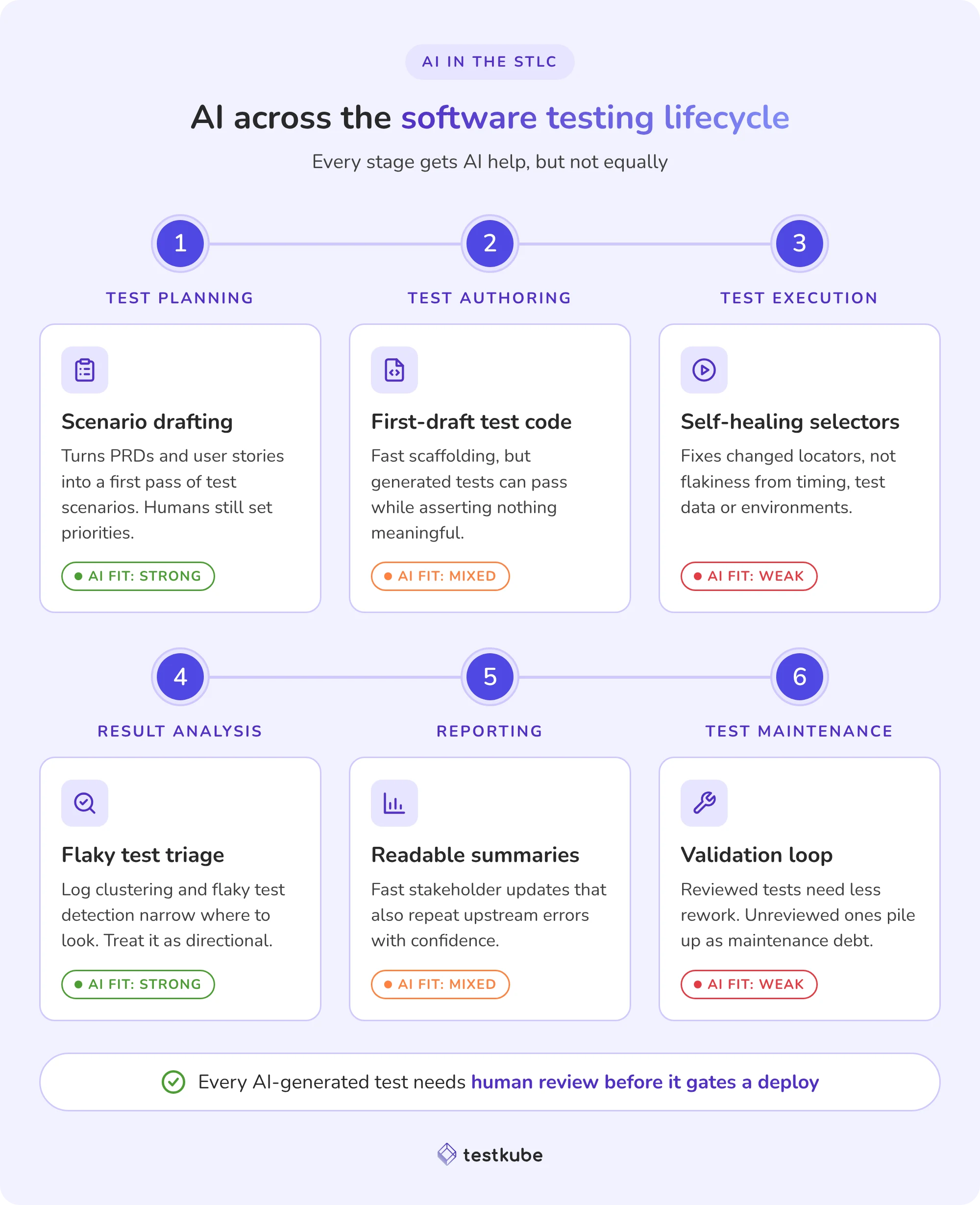
The software testing lifecycle (STLC) is the sequence of stages a team uses to plan, write, run, analyze, report on, and maintain tests. AI is most reliable in test result analysis and scenario drafting, and least reliable in autonomous execution and maintenance.
"Can AI just write and run our tests for us?" It's the question every QA team gets asked at least once a quarter now, usually by someone who watched a demo video.
Below, we go stage by stage through planning, authoring, execution, analysis, reporting, and maintenance, and cover what works, what falls short, and what vendors overclaim at each one.
Does AI Work Equally Well for Unit, E2E, and Performance Tests?
No. AI is most reliable on unit and integration tests, where the scope is narrow and there's a clear correct answer. It gets shakier on end-to-end tests, where timing and environment noise take over, and shakier still on performance testing, where there's no single clean baseline to grade a result against.
Test Planning and Strategy
AI in test planning is best at turning a product requirements document (PRD), user story, or acceptance criteria into structured test scenarios. That includes positive cases, negative cases, boundary conditions, and edge cases. A model produces a reasonably comprehensive first pass, and it's also decent at flagging ambiguous or under-specified requirements before anyone starts authoring tests against them.
AI starts to struggle when several conditions interact, instead of one requirement being tested on its own. The bigger risk is that the model sounds confident even when it misses something. For instance, it may list good test cases for login, password reset, and account lockout separately, but miss the case where a user resets a password after multiple failed login attempts. Because the output still looks polished, reviewers cannot assume it is complete. They still need to check the logic carefully.
"AI designs your test strategy" overstates what AI does. AI can draft scenarios while a human still owns prioritization, especially anywhere compliance requires a named, accountable decision-maker.
For a closer look at where planning-stage bottlenecks actually come from, see AI Test Automation: Fixing the Three New Testing Bottlenecks.
Can AI Write Your Test Cases?
Yes, for first drafts. Natural-language-to-test-code generation is mainstream at this point, and it's a real time-saver for first-draft test cases. If you've used Claude, Copilot, Cursor, or a similar tool to scaffold a test file, you already know this part isn't hyped.
The main failure mode: a generated test can compile, run, and pass while asserting something meaningless. The model produced something that looks structurally like a correct assertion, without reasoning about what the code under test is supposed to do. That's a different failure mode from a human writing a lazy test. It's confidently wrong in a way that's harder to catch on a quick read.
AI-generated test code also doesn't reproduce reliably. Run the same prompt against the same code twice and you often won't get identical test code back. A peer-reviewed study on ChatGPT code-generation non-determinism documented this directly, and it matters here because reproducibility is supposed to be part of the point of a test suite.
"AI writes your suite so you don't have to" is the hype claim to address here. The guardrail is simple: every AI-generated test needs human review before it gates a deployment. Keep that rule under deadline pressure.
One practical way to earn that review without slowing everything down: run a new or AI-generated test silently alongside your real suite, without letting it gate anything yet. That builds a track record of actual pass/fail behavior a human can look at before deciding whether the test is trustworthy enough to block a deployment.
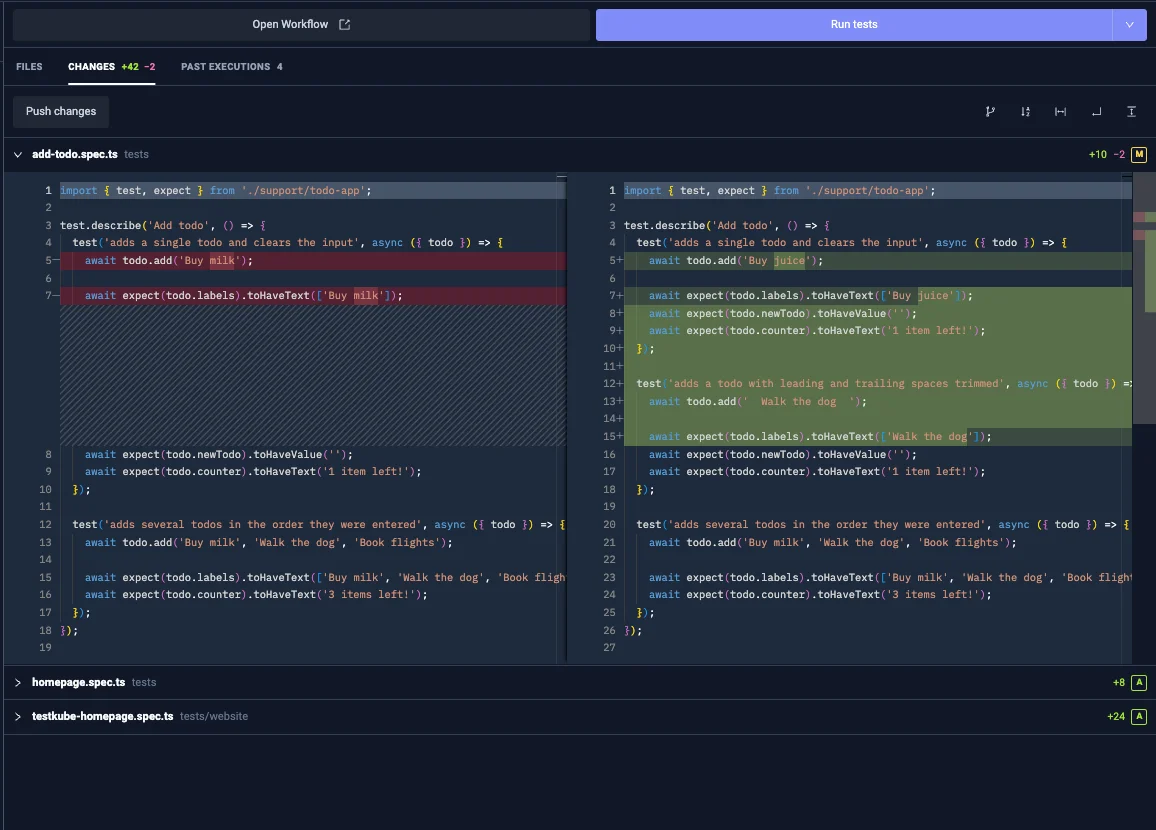
For more on what this looks like operationally, see Testkube AI agents for test authoring.
Test Execution
AI in test execution fixes three narrow problems: changed selectors, test prioritization, and minor visual differences. Vendors often lead with "self-healing" tests, but the useful part is narrower than it sounds. Self-healing can help when a UI element changes its selector but still does the same job. AI can also help choose which tests to run first based on recent code changes, and visual AI can reduce false failures caused by small browser or layout differences. These are useful improvements, but they solve specific problems, not all execution problems.
Self-healing locators do not fix test flakiness in general. They mainly help when an element's identifier changes but the element still behaves the same way. Most flaky tests fail for other reasons, such as timing issues, unstable test data, or differences between environments. In one widely cited study of 161 flaky-test fixes, async waits caused 45% and concurrency another 20%. For example, a checkout test may fail because the payment mock responds too slowly or the test account already has an item in the cart. Self-healing cannot solve those problems. Teams that expect it to reduce all flaky failures will likely be disappointed.
A bigger risk is that self-healing chooses the wrong element when more than one element looks similar. Take a checkout test where the real "Pay now" button changes. If another payment button on the page has similar text or styling, the test might attach to the wrong one and still pass. That turns a real failure into a false pass. In some cases, that is worse than a flaky test, because at least a flaky test fails loudly.
Be skeptical of claims about "fully autonomous test execution." Many of these claims come from polished agentic AI demos, not from real accuracy data. A demo is controlled and predictable. Your CI pipeline is not.
For a grounded framework on execution that doesn't depend on any of this working perfectly, see Test Execution: A 5-Step Framework That Actually Works.
Can AI Find the Root Cause of Test Failures?
AI narrows down where to look, but a human still verifies the cause. Test result analysis is the strongest AI use case in the STLC. Using large language models (LLMs) for flaky test detection and classification works well. Log summarization and clustering meaningfully cut the time spent separating signal from noise in a wall of CI output. Code-aware root cause suggestions are holding up in production: Google's Auto-Diagnose tool identified the correct root cause in 90% of 71 manually reviewed integration test failures.
The caveat: AI output in analysis is directional. AI is good at narrowing down where to look, not at delivering a verified final answer that needs no human checking. Accuracy also varies by language and framework, so what works well on your Java suite might be noticeably worse on your Python one.
In practice, AI-derived signals work best as a qualitative layer alongside the hard pass/fail gate, not a replacement for it. A confidence score or an anomaly flag on a test that technically passed is a prompt for a human to look closer. It is not a verdict to automate a release decision around.
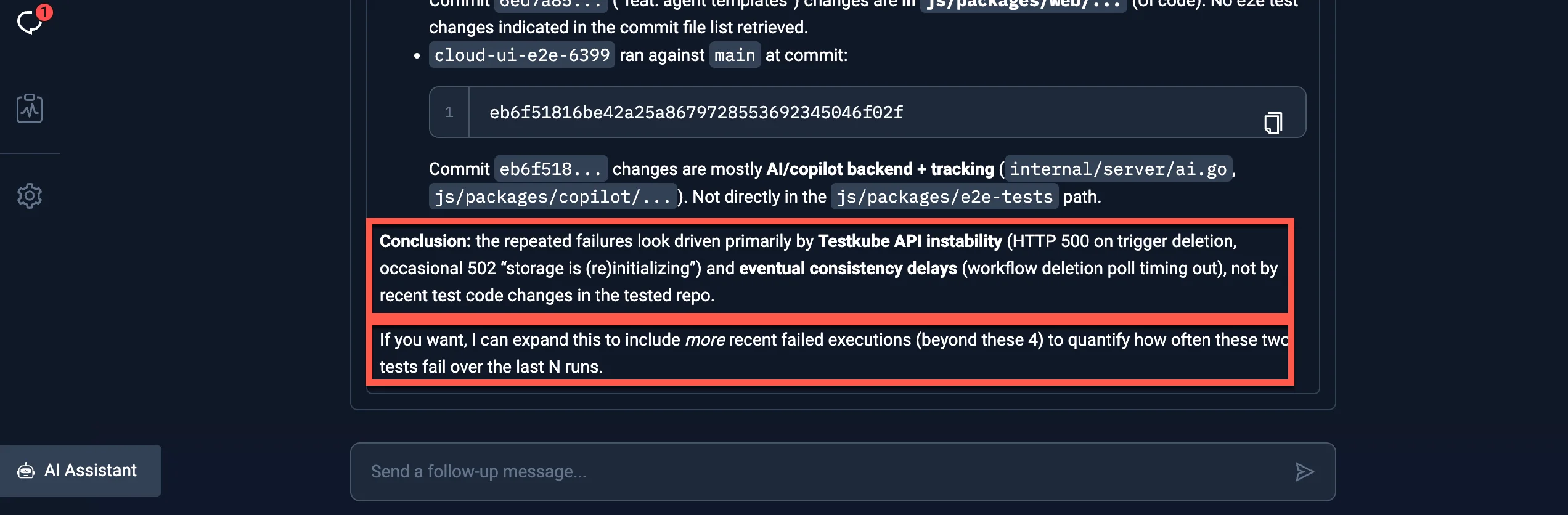
"AI finds your root cause" overstates what's actually happening. The more accurate framing is that AI accelerates triage and hypothesis generation. It doesn't replace verification, and treating it like it does is how a wrong hypothesis gets treated as a conclusion.
For more on how this plays out with orchestration across Kubernetes environments, see Testkube MCP Server: AI-Powered Test Orchestration for Kubernetes.
Reporting
Reporting is one of the easier places to see AI's value. It can turn test results, recent failures, and trends into a readable summary without someone building a dashboard or status update from scratch. AI can skip the manual log gathering across tools. It can report that checkout failures rose after the latest release, rank the most affected tests, and point to the likely area to review first. That's a useful time-saver, especially for stakeholder updates.
But reporting doesn't have its own distinct AI failure mode. It inherits errors from every stage upstream of it. A wrong root-cause summary from the analysis stage gets repeated in a report with total, unearned confidence, because the reporting layer has no way to know the input it's summarizing was already wrong. Structured, disciplined human reporting still beats an ad hoc AI summary, especially when a report will inform a real decision.
The failure mode to watch for on your own team is treating an AI-generated summary as a replacement for reporting discipline, rather than as an accelerant of a disciplined process that already exists. If the underlying process is sloppy, AI just makes the sloppiness faster and better formatted.
Read about Test Insights, which brings all of your test reports into one place.
Does AI Reduce Test Maintenance?
Only when AI-generated tests pass a review and validation loop first. Test maintenance is the biggest unsolved AI problem in the STLC right now.
Most organizations experimenting with generative AI in quality engineering are still stuck piloting rather than running at scale. Maintenance burden is a real driver of that gap. Teams pilot AI-assisted authoring, generate a wave of new tests, and then discover nobody scoped out who maintains them. AI has not solved this problem at the aggregate level yet, whatever a given vendor's roadmap slide claims.
The difference usually comes down to how the test got there in the first place. A test generated once, accepted on the first pass, and never checked against real results tends to pile up as maintenance debt later. A test that went through a validation loop first, where its actual pass/fail behavior got checked before anyone trusted it, generally needs less rework down the line. The loop doesn't eliminate maintenance, but it front-loads some of the correction that would otherwise happen the hard way, in production, months later.
For a closer look at what that kind of loop looks like, see Continuous Validation: Fix the AI Coding Bottleneck.
Unreviewed AI-generated tests are as often a maintenance cause as a maintenance cure. Duplicated, non-deterministic, or silently wrong tests pile in faster than a team can review them.
"AI-generated tests need less maintenance" is only true when paired with review discipline. Without that discipline, AI increases net maintenance burden instead of reducing it.
How Should Teams Adopt AI Across the STLC?
Adopt AI stage by stage: use it to draft, detect, and summarize, and keep a human review gate in front of anything it generates. No STLC stage gives a clean yes or no on AI in testing. Planning gets help drafting scenarios but not prioritizing them. Authoring gets faster but needs more review, not less. Execution gets narrower fixes than the marketing suggests. Analysis is the one place AI earns near-unqualified praise, and even there it's directional. Maintenance is where all the unreviewed shortcuts from earlier stages show up as a bill.
Here's what that means for how you roll AI into your own testing practice:
- Match the tool to the stage. AI is strongest when it augments judgment with speed: drafting, detection, summarizing. It's weakest and riskiest when it replaces verification entirely: final assertions, root cause verdicts, autonomous execution decisions.
- Put a review gate in front of anything AI generates, and don't skip it under deadline pressure. It's the one practice common to every stage where AI is working well.
- Budget for the pilot-to-scale gap as the norm, not a sign your team is falling behind. The World Quality Report 2025 found that 89% of organizations are piloting or deploying GenAI in quality engineering, but only 15% have reached enterprise-wide implementation.
- Treat what goes to a third-party LLM as a real data-exposure decision that needs sign-off, not a default setting someone enabled in a trial.
- Expect and respect skepticism from teammates who want to double-check AI output before it gates a release. That instinct is rational.
Conclusion
AI's value across the STLC is real, but it's still uneven. Knowing where it's strong, where it's weak, and where it's just hype is what separates useful adoption from an expensive mistake made on a demo's promise.
For a closer look at how Testkube handles each stage, see the Testkube documentation.
Want to see how Testkube fits into a specific stage of your own testing lifecycle? Talk to the team.
Frequently Asked Questions
{{banner-get-started}}
About Testkube
Testkube is the open testing platform for AI-driven engineering teams. It runs tests directly in your Kubernetes clusters, works with any CI/CD system, and supports every testing tool your team uses. By removing CI/CD bottlenecks, Testkube helps teams ship faster with confidence.
Get Started with a trial to see Testkube in action.